
How to Choose the Best Home Theater Consultant: Why Climax Cinemas Stands Out

The best home theater consultant is one who listens to how a family actually plans to use the room, understands acoustics beyond just placing speakers, and can show a track record of finished projects. At Climax Cinemas, we work through detailed design conversations with every client, covering colour, seating, soundproofing, and technical build, before a single speaker goes in.
Key Takeaways
- A good home theater consultant should ask about lifestyle and room use, not just budget and square footage.
- Acoustic treatment matters as much as the equipment itself, especially in apartments and multi-storey buildings.
- Look for consultants who involve you in design decisions rather than handing over a fixed package.
- Real project examples and technical specification sheets tell you more than marketing claims.
- Home theater setup cost varies significantly based on soundproofing needs, seating, and equipment tier.
Building a home cinema is a bigger decision than most people expect going in. It isn’t just about buying a projector and some speakers, it’s about getting the room, the sound, and the design to work together in a space you’ll actually use for years. That is where the right home theater consultant can make a difference, helping you create a room that works well for both the first day and the years that follow. At Climax Cinemas, we have worked through this process with families across Kerala, and one project in particular, a 21st-floor apartment in Kakkanad, shows what a properly managed home theatre build actually involves from first conversation to final walkthrough.
What to Look for in a Home Theater Consultant
A Consultant Who Asks What Your Need
The first sign of a solid home theatre expert is that they ask how the room will actually be used before talking about equipment. Will it host film nights with friends, or mostly be used by one or two people? Does the family want a colour scheme, or is the priority pure performance? These questions shape everything that follows, and a consultant who skips straight to a product list is missing the point.
In our recent home theater installation in Kakkanad, the family, Girish, his wife Anju, and their daughter Ayushi, each had different priorities. Girish wanted the room to feel like a high-end cinema, Anju wanted a calm, distinctive design without relying on bright colours, and Ayushi cared about how the room would feel to spend time in regularly. Getting all three views into one coherent design took five to six detailed discussions before construction even began.
Real Experience With Acoustic Challenges
Sound leakage, structural obstacles, and room shape all affect how a home theatre performs, and these issues show up differently in every building. A consultant with genuine experience should be able to talk through how they’ve solved problems like these before, not just describe a standard installation process.
In the Kakkanad project, the room sat on the 21st floor of an apartment building, which meant sound leakage into neighbouring units was a real concern from day one. The solution involved a layered soundproofing build, Mass Loaded Vinyl, an air gap, Rockwool insulation, Sheetrock panelling, and acoustic panels as the visible finish. A structural pillar running through the room was wrapped in acoustic material so it blended into the design, and a balcony was enclosed and folded into the theatre space entirely.
A Good Track Record
Anyone can claim expertise. What matters is whether a consultant can show finished projects with specifics, room dimensions, speaker configurations, and the problems they solved along the way. This is one of the clearest ways to judge a home cinema installation company before committing.
How an Experienced Consultant Approaches a Project
A reliable home theater consultant follows a clear, structured process, and it usually begins with a detailed discussion about how the room will be used and who will use it. This is followed by a design stage, where colour, seating, and layout are agreed with the family before any work starts.
Next, the acoustic plan is prepared around the specific building and room, and the equipment is selected to suit the room size and intended use. The consultant or home theater installation team then stays involved through installation and the final walkthrough, and makes sure the finished room matches the agreed brief.
This is what you need for your dream home theater, and this approach keeps the project organised, reduces uncertainty in cost and timeline, and ensures the result reflects your needs.
What a Proper Technical Build Looks Like
A capable home theater consultant should also be transparent about the actual equipment going into the room. The Kakkanad installation ran on a 7.2.2 Dolby Atmos configuration:
- LCR speakers: JBL Studio 6 LCR, quad drive in-wall units
- Surround speakers: JBL Studio 6IW, 6.5-inch two-way in-wall speakers
- Atmos speakers: JBL Arena 260C, mounted for overhead sound
- Subwoofers: two 12-inch JBL Stage 220P powered units
- Projector: BenQ W2720i, 4K with 2500 lumens
- Screen: Elite Screens 135-inch acoustic transparent 4K screen
- Media player: Apple TV 4K
- AVR: Denon AVC-X3800
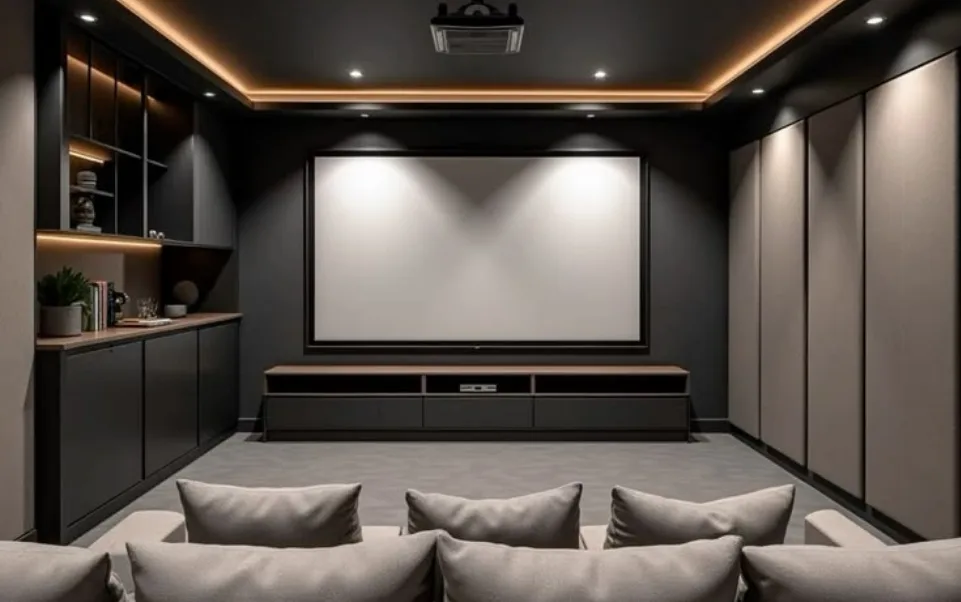
All equipment- the AVR, subwoofers, and LCR speakers, was hidden behind the screen, with pet slats lining the back wall doing double duty as both acoustic treatment and a design feature. A duct-type air conditioning system replaced a standard split unit, since a visible indoor unit would have broken the room’s clean look.
Understanding Home Theater Setup Cost
Home theater setup cost depends heavily on factors that aren’t always obvious at the outset: the amount of soundproofing a room needs, seating quality, screen size, and how much custom carpentry or design work goes into hiding equipment and cabling. A room on a high floor with sound leakage concerns, like the Kakkanad project, needs a more involved soundproofing budget than a ground-floor room with fewer acoustic constraints. This is another reason why an experienced consultant matters, since underestimating these factors early on tends to cause budget surprises later in the project.
Why Families Choose Climax Cinemas
We have worked as home theatre dealers in Kerala for long enough to understand that no two rooms, or families, want the same thing. Before Girish’s family settled on us, they researched vendors across Kerala, Bangalore, and Chennai, watching reviews and reaching out to several companies. What brought them to Climax was a visit to our experience centre, where Girish could experience the build quality and sound system before deciding on the project.
That kind of decision-making process, comparing options, visiting in person, and asking detailed questions, is exactly what we’d recommend to anyone evaluating a home theater consultant. The right partner should welcome that scrutiny rather than rush you toward a quick sign-off.
Conclusion
Choosing the right home theater consultant comes down to whether they treat your project as a genuine design and engineering challenge, rather than a standard package with a few customisable options. The Kakkanad project shows what that process looks like in practice: repeated design conversations, real solutions for a genuinely difficult acoustic environment, anda finished room designed around the family’s needs and preferences. Girish now describes the room as giving him the same feeling as watching a film in a five-star cinema without leaving home.
If you are considering a home cinema installation and want to work with a home theatre expert who takes the design process seriously, get in touch with Climax Cinemas, and we will talk through what’s possible for your space.
Frequently Asked Questions (FAQs)
Q1:What questions should I ask a home theater consultant before hiring them?
Ask how they handle acoustic challenges specific to your building, whether they involve you in design decisions throughout the project, and if they can show detailed examples of past installations with real specifications rather than general claims.
Q2: Does home theater setup cost vary a lot between projects?
Yes, cost depends on factors like soundproofing requirements, room size, seating choice, screen and speaker specifications, and how much custom design work goes into the room, so two similarly sized rooms can have quite different budgets.
Q3: How long does a typical home cinema installation take from first meeting to
Timelines vary by project complexity, but a well-planned installation usually involves several design discussions before construction starts, followed by the acoustic and technical build, which can take a few weeks to a few months depending on the scope of work.
Q4: Why does acoustic treatment matter more in apartments than standalone homes?
Apartments share walls, floors, and ceilings with neighbours, so sound leakage becomes a bigger concern, which usually means layered soundproofing materials are needed to prevent bass and sound from travelling into adjoining units.
Q5: Can a home theater be built around a specific colour or design preference?
Yes, a good consultant can build the acoustic and technical elements of the room around a chosen colour scheme or design brief, working the necessary panelling and treatments into the visual design rather than treating them as separate concerns.