
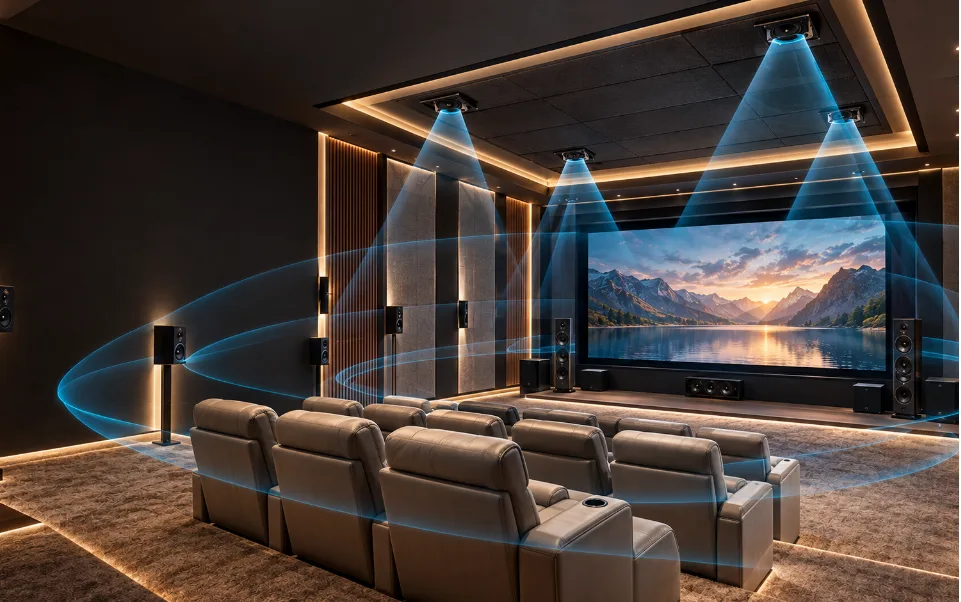
Dolby Atmos vs DTS:X vs Auro-3D: Which Immersive Audio Format Is Right for Your Home Theatre?

For most homes, Dolby Atmos is the safer pick because it has the widest range of encoded titles and the most detailed installation guidance, so most AV receivers lean on its layout even when playing DTS:X. DTS:X offers a more flexible, speaker-agnostic approach, while Auro-3D suits audiophiles who value true, separately recorded channels over object-based mixing.
Key Takeaways
- Dolby Atmos, DTS:X and Auro-3D all aim to place sound above and around the listener, not just to the sides.
- Dolby Atmos has the largest film catalogue and is treated as the default layout by most receiver brands.
- DTS:X skips a fixed speaker map and instead calculates output based on whatever speakers are actually present.
- Auro-3D uses true, dedicated channels rather than object-based panning, which some audiophiles prefer for music.
- DTS:X tops out at 7.1.4, while Dolby Atmos can technically scale up to 34 speakers in a home system.
- A well-designed room can often support more than one format at once, since the ceiling and height speaker positions overlap.
Dolby Atmos vs DTS:X vs Auro-3D
Before comparing formats, it helps to understand the numbers you will see attached to each one, because this is where a lot of confusion starts. The old naming convention, credited to sound engineer Tomlinson Holman, used figures like 5.1 to describe six channels of signal, with the “.1” referring specifically to the low frequency effects (LFE) channel rather than a physical subwoofer. Over time, that meaning shifted. Today, most people use 5.1 to mean five main speakers plus one subwoofer, and 5.2 to mean five speakers with two subwoofers.
With height and overhead speakers added into the mix, you now see three-number systems such as 7.2.4, which reads as seven main speakers, two subwoofers, and four overhead speakers. Auro-3D breaks from this pattern slightly and uses its own numbering, which we will cover shortly.
| Feature | Dolby Atmos | DTS:X | Auro-3D |
|---|---|---|---|
| Year introduced | 2012 | 2015 | 2010 |
| Approach to sound | Object-based | Object-based | Channel-based (true channels) |
| Maximum home layout | Up to 34 speakers (24.1.10) | Capped at 7.1.4 | Up to 13.1 (with VOG channel) |
| Ceiling speaker placement | Rails aligned with front L/R | Spokes from the main listening position | Height layer directly above ear-level speakers |
| Film library size | Largest | Moderate | Smallest |
| Best suited for | Blockbuster films, general home cinema | Rooms with flexible or uneven speaker counts | Music mixes and audiophile listening |
If you have started planning a dedicated cinema room, you have probably heard about Dolby Atmos, DTS:X and Auro-3D. Working out Dolby Atmos vs DTS:X vs Auro-3D is not really about choosing one, since none of these formats are inferior to one another. It is about understanding how each one places speakers, how much film and music content actually exists for it, and how that fits into the room you have available. This blog explains where these formats came from, how the speaker layouts differ, and which one makes sense depending on how you use your room.
Dolby Atmos
Dolby Atmos launched in 2012 and has become, by a wide margin, the format most cinema rooms are designed for. It reached the market before DTS:X, backed by aggressive marketing and, more practically, a very thorough installation manual that installers still lean on today.
Because so many home cinemas already follow Dolby’s layout guidance, and because DTS:X speaker positions end up in a similar place anyway, most rooms are simply built to Dolby’s spec and then decode both formats through the same speakers.
A full home Dolby Atmos setup can technically support up to 34 speakers, described as 24.1.10, although most residential installations use smaller configurations. The more common home configurations run from 5.1.2 (three front speakers, two surrounds, a subwoofer and two overhead speakers) up to 7.2.4 or beyond.
Some studios limit the encoded channel count on their Dolby Atmos discs to 7.1.4 for home releases, even though the format allows for more. If you have built a room with the full complement of Dolby channels, some speakers may receive less activity on certain titles because of how the soundtrack was mixed. That is not a fault with your system, it is simply how that particular disc was mixed.
Dolby arranges its height and ceiling speakers along rails formed by the position of the front left and right channels, meaning you find the correct overhead position by lining it up directly above its associated front speaker.
Also Read:5.1 vs 7.1 vs Dolby Atmos: Which Sound System is Best?
DTS:X
DTS has been part of the cinema audio conversation, and DTS:X is its answer to Atmos. It arrived in 2015, a few years after Dolby’s format, and while there are fewer DTS:X encoded titles on the market compared with Atmos, most AV receivers decode both formats without any trouble.
The practical difference between Dolby Atmos vs DTS:X comes down to how each format positions its ceiling speakers. Where Dolby uses rails tied to the front speakers, DTS:X places ceiling speakers on spokes radiating out from the main listening position. In practice, the end result usually lands in a similar spot in the room, which is why many installations follow Dolby’s layout while using the same speaker system to support DTS:X.
One meaningful difference is the ceiling. DTS:X caps out at a maximum of 7.1.4 for home use. You can still add extra subwoofers beyond that single placeholder number, but the overhead channel count stops at four. If you were weighing DTS:X vs Auro-3D, it is worth knowing that DTS:X also offers a Pro variant capable of 14.1.15, aimed at larger, more ambitious rooms.
Auro-3D
Auro-3D was actually first to market, launching in 2010, two years ahead of Dolby Atmos. Despite that head start, it has never gained the same foothold in mainstream cinema releases, partly because Dolby and DTS were already deeply embedded in Hollywood’s production pipeline.
What makes Auro-3D stand out, and why it still has a loyal following among audiophiles, is that it is the only one of the three that uses true, separately recorded channels rather than object-based panning. In practice, this means sound can be captured using a special multi-element microphone during recording, preserving genuine spatial information rather than recreating it digitally afterwards. That approach appeals particularly to music producers, and a fair number of concert films and music videos have been mixed specifically for Auro-3D.
Auro-3D organises its speakers into three layers: the ear-height bed channels, a height layer positioned directly above them, and a single Top channel, sometimes called the Voice of God (VOG), mounted centrally in the ceiling.
How Object-Based Audio Works?
Dolby Atmos and DTS:X are both described as object-based, which sounds more complicated than it is. Rather than assigning sound permanently to a fixed channel, these formats store a base of 7.1.2 channels, similar to old-fashioned 7.1 surround, alongside metadata that tells your AV receiver where individual sound objects should travel around the room.
Commercial cinema mixes can use as many as 118 separate objects, though home versions use object clustering to keep the processing demands manageable, so the actual number used at home is considerably smaller. Your receiver’s built-in decoder reads this metadata and routes the signal to whichever speakers you actually have installed.
IMAX Enhanced
IMAX Enhanced is not a fourth competing audio format. Instead, it is a certification programme applied to content and equipment, usually layered on top of DTS:X decoding, that aims to preserve more of the original theatrical mix and expanded aspect ratio when a film is remastered for home viewing.
Which Format Should You Actually Build Around?
So many receivers, speakers and streaming platforms now support Atmos by default, with DTS:X and Auro-3D riding along as compatible extras rather than separate purchasing decisions.
If you mostly watch films
Dolby Atmos is the practical choice, simply because it has the broad content library and the clearest installation documentation. Most blockbuster releases arrive with an Atmos track.
If your room has an unusual speaker count
DTS:X’s flexible, speaker-agnostic calculation can be a genuine advantage in awkward or irregularly shaped rooms, since it is less rigid about exact speaker positioning.
If you care about music and audiophile mixes
Auro-3D’s true-channel recording approach gives it an edge for concert footage and music-focused content, and many rooms already built for Atmos or DTS:X only need a couple of extra speakers to support it as well.
Dolby’s dominant content library and detailed manual make it the sensible default for most cinema builds. DTS:X earns its place through flexibility rather than market share. Auro-3D, despite being first to arrive, remains a smaller-format option, particularly for music-focused listening. Since the underlying speaker positions for all three overlap so heavily, a thoughtfully designed room rarely has to choose just one.
Conclusion
Choosing between these immersive audio formats is only the first step. Speaker placement, room acoustics and receiver setup all decide whether that format actually sounds the way it should. Get in touch with Climax Cinemas if you would like a home cinema built around the sound experience you actually want.
Frequently Asked Questions (FAQs)
Q1: Why does DTS:X have fewer movie titles than Dolby Atmos?
A1: Dolby Atmos reached the market first among the two object-based formats and secured wider backing from Hollywood studios early on, which gave it a head start in film encoding that DTS:X has not fully closed, even though most receivers support both formats equally well.
Q2: Is Auro-3D worse than Dolby Atmos or DTS:X because it has fewer titles?
A2: No. Auro-3D uses a different, channel-based recording method rather than object-based panning, which some engineers and audiophiles consider more spatially accurate for music. It has fewer titles mainly because it never became as embedded in mainstream film studios as the other two formats.
Q3: Do I need a special AV receiver to use these immersive audio formats?
A3: Yes, your AV receiver needs built-in decoders for whichever format you want to use. Most mid-range and premium receivers sold today support both Dolby Atmos and DTS:X, while Auro-3D decoding is usually reserved for specific higher-end models.