
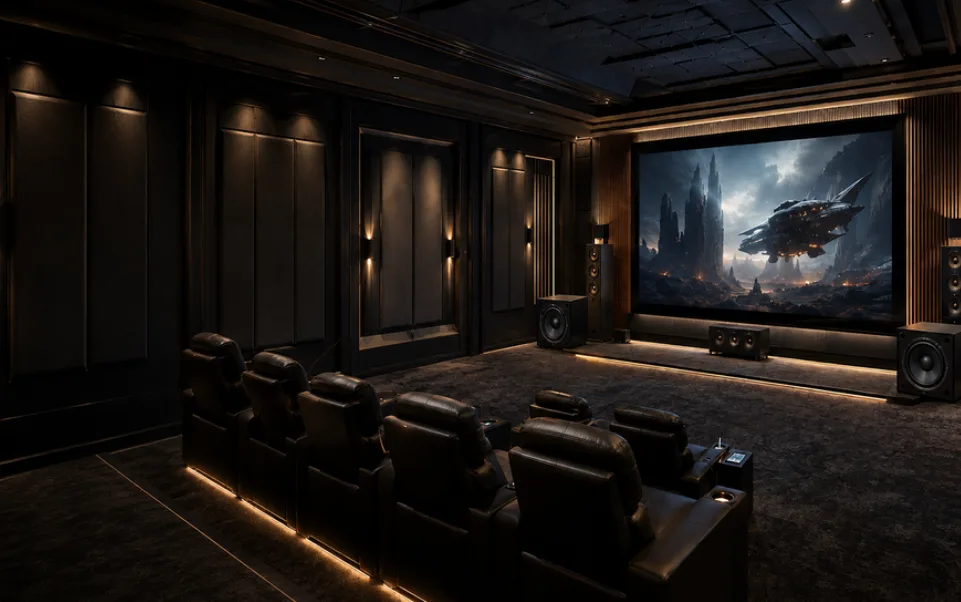
What are Common Subwoofer Placement Options for Optimal Sound?

The common subwoofer placement options for optimal sound are corner placement and front wall positioning, but the right one for your room depends on how the space is shaped and how many people usually sit in it. Get the placement wrong, and even an expensive subwoofer can sound boomy in one seat and thin in another. Get it right, and the bass stops feeling like an afterthought and starts sounding like it belongs in the mix.
At Climax Cinemas, we install home cinema systems and subwoofer placement is one of those things we do with utmost care and planning.
Why Subwoofer Placement Changes the Sound
A subwoofer doesn’t just play low notes louder. It excites the room itself, and rooms respond unevenly to bass frequencies. Move a sub a metre in either direction and the bass at your seat can jump or nearly vanish, even though nothing about the speaker changed.
The Corner Placement Option
Putting a subwoofer in a corner is the classic choice, and for good reason. Corner placement can also excite more room modes, which may create stronger peaks and dips depending on the room. If your room is on the larger side and you want the bass to really fill the space, a corner often does the job with the least effort.
The trade-off is consistency. Bass from a corner-placed sub can vary noticeably from seat to seat, sounding punchy in one spot and less defined a few feet away. For a single-listener setup or a smaller room, this rarely matters much. For a multi-seat home cinema, it’s worth keeping in mind.
Front Wall, Off-Centre
Placing the subwoofer along the front wall, roughly a quarter of the way in from one side, tends to smooth out seat-to-seat variation better than a corner does. You lose a bit of raw output compared to corner placement, but what you gain is more even bass across different seats, which matters a great deal in a proper home cinema installation where more than one person is watching.
This is often our starting recommendation for clients building a dedicated cinema room with a few rows of seating, since even bass across the whole room usually matters more than a couple of extra decibels in one spot.
Along the Side Wall
Side wall placement gets less attention, but it has its uses, particularly in irregularly shaped rooms where corner or front wall positions aren’t practical. It won’t deliver the same bass reinforcement as a corner, though in the right room it can avoid some of the harsher peaks that corners sometimes create.
Using Two Subwoofers
For anyone serious about even bass across a whole room, using two subwoofers rather than one is worth considering. Placed symmetrically, usually one in each front corner or at matching points along the front wall, two subs cancel out a lot of the peaks and dips that a single unit can’t avoid. This setup costs more, obviously, but for larger rooms or serious subwoofer in home theater builds, it’s often the difference between good bass and genuinely even bass.
Choosing the Right Subwoofer Placement
| Placement | Output | Bass Uniformity | Best For |
|---|---|---|---|
| Corner | High | Medium | Large rooms |
| Front wall | Medium | High | Multiple seats |
| Side wall | Medium | Room dependent | Irregular layouts |
| Dual subs | High | Excellent | Dedicated cinemas |
What to Avoid When Positioning a Subwoofer
A few placement habits cause more problems than they solve.
- Pushing the subwoofer directly into an enclosed cabinet or alcove, which traps sound and creates muddy, boxy bass
- Placing it too close to a wall without leaving any gap, since this can exaggerate certain frequencies unpredictabl
- Assuming one placement works for every room, when in fact room size and shape change the outcome every time
- Ignoring the main listening position entirely, since bass response there matters more than how it sounds standing near the unit itself
Active vs Passive Subwoofers
When it comes to active vs passive subwoofers, active subwoofers have their own built-in amplifier, which makes them more flexible to position anywhere with a power outlet nearby. Passive subwoofers rely on an external amplifier and a dedicated speaker cable run, which can limit where they realistically sit in relation to the rest of your system. Most home cinema setups today lean towards active subwoofers simply because of this flexibility.
Why Getting this Right is Worth the Effort
A well-chosen amplifier and speaker set can still sound flat if the bass underneath it is uneven or weak in the seats that matter most.
As home theatre dealers in Kerala, we have measured enough rooms to know that the correct placement on paper doesn’t always match what a specific room actually needs. Furniture, wall material, ceiling height, even where the doorway sits, all of it plays a part.
Getting a Proper Assessment
If you are setting up a new home theater system or trying to fix bass that’s never quite sat right, the more reliable approach is having someone measure the room properly rather than guessing based on general advice. As a home theatre expert in Kochi, we walk through exactly this process with clients, testing a few positions before settling on the one that actually performs best in that specific space.
Get the Right Placement for Your Room
Subwoofer placement isn’t something that follows one fixed rule for every room. What works in a small den won’t necessarily work in a larger cinema room, and what sounds fine for one listener might sound uneven for four.
At Climax Cinemas, we handle this as part of every home cinema project we take on, testing placement properly rather than defaulting to the same spot for every client. If your bass has never sounded quite right, or you are planning a new setup and want it done properly from the start, get in touch with Climax Cinemas and we will help you work out what your room actually needs.
Frequently Asked Questions (FAQs)
Q1: What is the best subwoofer placement for a home theatre room?
A1: There isn’t one single best spot for every room, but corner placement usually gives the most output, while front wall placement a quarter of the way in tends to give more even bass across multiple seats.
Q2: Should I use one subwoofer or two for better bass?
A2: Two subwoofers, placed symmetrically in the room, generally give much more even bass from seat to seat compared to a single unit, which makes them worth considering for larger rooms or multi-row cinema setups, though a single well-placed subwoofer works fine for smaller spaces or single-listener rooms.
Q3: Does the type of subwoofer affect where I can place it?
A3: Yes, active subwoofers are easier to position since they only need a power outlet nearby, while passive subwoofers depend on an external amplifier and cable run, which limits placement options somewhat.