
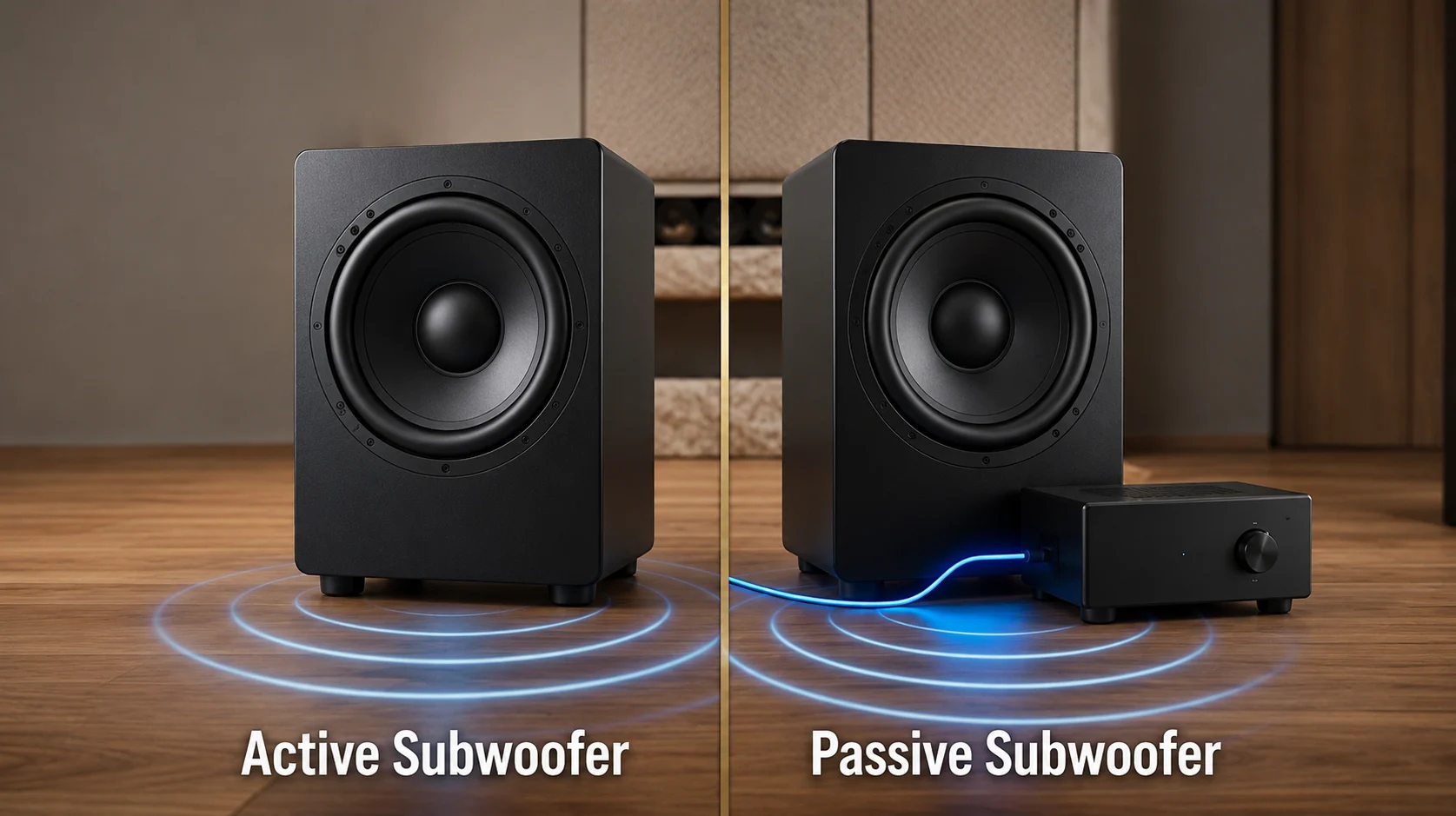
Active vs Passive Subwoofers: Which One Should You Choose?

If you are trying to decide between active vs passive subwoofers, it is important to note that an active subwoofer has its amplifier built in, a passive one does not. That single difference is what everything else flows from. One is simpler to set up. The other gives you more room to customise.
Active & Passive Subwoofers
A powered home theater subwoofer, or active unit, houses the amplifier inside the cabinet itself. The driver, the crossover, and the amp are all in one box. You run a cable from your receiver, plug it into the wall, and it is ready to go. The manufacturer has already done the work of matching those internal components to each other, so there is no guesswork on your end.
There are two components that make up a passive subwoofer: the cabinet and the driver. Nothing powering it internally. You have to provide an external amplifier, and that amplifier has to be matched to the subwoofer properly. Too little power and the bass will feel thin. Too much, or the wrong kind, and you risk damaging the driver. It is not complicated if you know what you are doing, but it does require a bit more knowledge to get the right home theater subwoofer installation.
Where Each Subwoofer Type Gets Used
Active subwoofers are the go-to for most home cinema setups and living room audio systems. They work well with AV receivers, they are straightforward to configure, and there are solid options across a wide range of budgets. If someone is putting together their first proper home theater speaker system, or even their third, an active unit is almost always where we start the conversation.
Passive subwoofers show up more in custom home cinema installations, professional environments, and systems where the person already owns a quality amplifier with spare capacity. There is a logic to it: if you have a strong external amp doing nothing, using a passive subwoofer to put it to work makes sense rather than buying a powered unit with a built-in amp you do not need.
Active vs Passive Subwoofers
The difference between active and passive subwoofer:
| Feature | Active Subwoofer | Passive Subwoofer |
|---|---|---|
| Built-in amplifier | Yes | No |
| Setup complexity | Low | Higher |
| External amp required | No | Yes |
| Best suited for | Home theater, everyday use | Custom or professional installs |
| Component flexibility | Moderate | High |
| Typical total cost | Single unit cost | Subwoofer plus separate amp |
| Upgrade path | Replace the whole unit | Upgrade amp or driver separately |
The Sound Quality
People want to know which sounds better. Honestly, that is not the most useful frame for the question. A well-made active subwoofer, properly placed and calibrated, will produce bass that most people in a home setting would be very happy with. The internal components are matched at the factory, so the system is coherent from the start.
A passive subwoofer paired with the right amplifier can go further, but the word right carries a lot of weight there. Match it poorly and you will actually end up with worse results than a decent powered unit would give you. Beyond that, room acoustics and where you physically put the subwoofer tend to shape the bass quality more than the active versus passive distinction does. That corner placement, that distance from the main listening position, matters a lot.
Active vs Passive Subwoofers: Which Fits Your Situation
Building a home cinema from scratch:
Go active. The setup is cleaner, it works natively with most AV receivers, and you do not need to worry about amplifier matching. Most people in this position are better served by spending their budget on a good powered unit and getting the placement right.
Expanding a custom or high-end system:
Passive might make sense here, particularly if you have amplifier headroom available and want the option to upgrade individual components over time without replacing the whole subwoofer.
Not sure where you land:
That is fine. The subwoofer type is genuinely one of the smaller decisions in a home audio build. Room treatment, speaker placement, and the quality of the source signal often matter more than whether the amp sits inside the cabinet or beside it.
A Few Things to Know Before You Buy Subwoofer
- Placement affects bass way more than most people think, and a subwoofer in the wrong spot in the right room will underperform against a cheaper unit placed well.
- If you are going active, check that your AV receiver has a dedicated subwoofer output. Most do, but older models sometimes do not.
- Passive setups require a bit of homework on impedance before you buy anything. The subwoofer and the amplifier need to be compatible on that front, and getting it wrong does cause genuine issues down the line
- As for volume, good bass is about quality and integration, not how loud it gets. A well-integrated subwoofer should feel like part of the sound, not separate from it.
What We Do at Climax Cinemas
We do not pick a subwoofer type and work backwards from it. When we are helping someone with a home subwoofer installation, trusted home theatre dealers in Kerala start with the room dimensions, the existing equipment, and what the space is actually used for. Everything from speaker placement to subwoofer choice follows from that initial picture of the room and how it gets used.
The goal is always a system that sounds good in that specific room for that specific person, not a setup that looks impressive on paper but does not actually work in practice.
If you are planning a home audio or cinema installation and want to talk through your options, we are happy to help. Visit Climax Cinemas to get in touch with our team.
Frequently Asked Questions (FAQs)
Q1: Is an active subwoofer the better choice for a home theater room?
A1: For most home theatre setups, yes. Because the amplifier and driver are paired at the manufacturing stage, there is nothing to figure out on your end. You connect it to your receiver’s subwoofer output, dial in the level and crossover settings, and it is done. That straightforwardness is why powered subwoofers dominate home cinema installations. The main reason to look at a passive unit instead is if you already have a spare amplifier you want to put to use, or if you are building a fully custom system and want to control each component independently.
Q2: Does it matter where I put the subwoofer in the room?
A2: Yes, quite a lot actually. Bass frequencies interact with room boundaries in ways that either reinforce or cloud the low end, and the wrong placement can make even a good subwoofer sound muddy. When we set up systems for clients, we spend real time on this rather than just plugging it in wherever is convenient.