
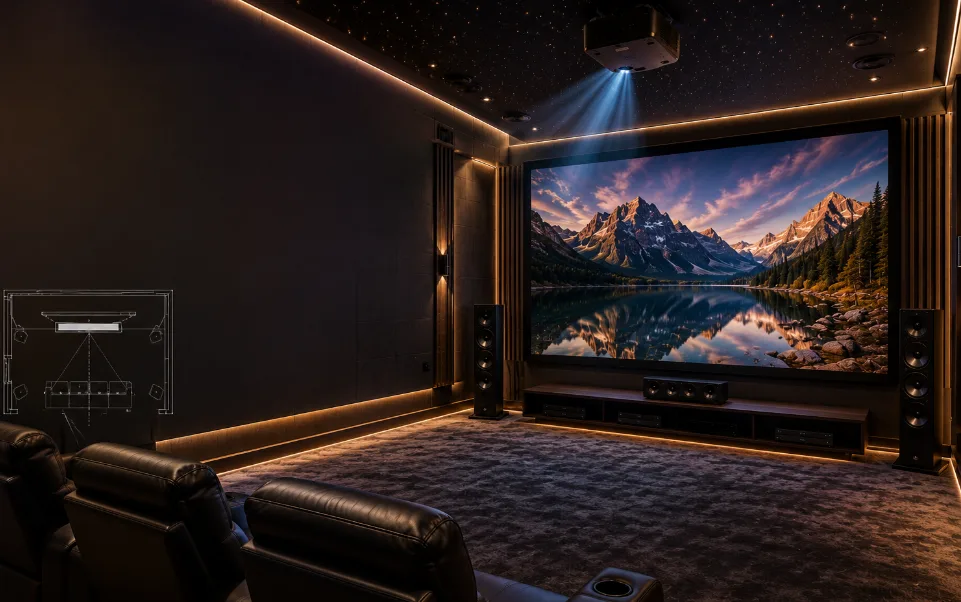
How to Choose the Right Home Theater Project Screen Size for Your Room?

The right home theater projector screen size for your room depends mainly on two things, such as how far you will be sitting from the screen, and how wide your wall actually is. A home theatre screen that looks very huge in a showroom can feel cramped or overpowering once it’s on your wall at home, and making this wrong is one of the most common mistakes when choosing and setting up a home theatre.
Viewing Distance
Most people go screen shopping with a size in mind before they have even measured their room. That’s working backwards.
The better starting point is the distance between where you will be sitting and where the screen will go. There is a rough rule that works well in practice, that is your screen width should be about half your viewing distance. So if your sofa is 4 metres from the wall, you’re looking at a screen roughly 2 metres wide.
This isn’t a rigid formula, but it gives a sensible starting point. Sitting very close to a large screen stresses your eyes and this can make the image look pixelated as well.
What If You Have a 4K Projector?
With a 4K projector screen, you can comfortably sit a bit closer than older setups allow, as the image remains sharp even at shorter distances. If you have invested in a 4K projector for home theater, going for a slightly larger screen size makes more sense and also the picture will still hold up very well.
Room Size & Layout
It’s not just about the viewing distance. The actual dimensions of the room, the ceiling height, the position of doors and windows, and where lights sit all affect what screen size makes sense.
A screen that’s too wide for a narrow room means people sitting on the sides will be watching at an angle, which isn’t comfortable for long. A screen that’s too tall in a low-ceilinged room can look awkward and may not even fit once you account for the projector mount and speaker placement.
Some practical things to check before deciding on size:
- Measure the wall width where the screen will go, including any obstructions like light switches or wall-mounted speakers
- Check ceiling height, and also note where any ceiling lights or beams are
- Think about where everyone will actually sit, not just the central position
Aspect Ratio
It is important to note that most home theatre screens come in a 16:9 ratio, which matches standard HD as well as 4K content. Some people go for a wider 2.35:1 ratio if they mainly watch films rather than TV shows, since movies are often shot in a wider format.
For most home setups, 16:9 is the practical choice, and the best projector screen for home theater use in a regular living room or dedicated room will almost always be in this format.
Screen Material and Gain
The material it’s made from affects how bright and clear the image looks, which ties into how well your projector performs in your room’s lighting conditions.
When a room has a lot of natural light, you will need a screen that has a higher gain, which means it will reflect more of the projector’s light back towards the viewer. Dedicated dark rooms can usually work really good with lower gain screens. Getting this right matters as much as the size, because a screen that’s technically the right dimensions but the wrong material for your room can still look underwhelming.
Home Theatre Setup Cost
Screen size does affect price, but not always in a straight line. A larger screen in a budget material might cost less than a smaller screen in a high-quality fabric with better light rejection. Home theatre setup cost depends on the combination of screen, projector, mounting, and installation together, not on any one piece in isolation.
You should consider the whole picture rather than buying the largest screen at the cheapest price, since the cheapest option can lead to an unattractive result that doesn’t actually look good in the room.
Best Home Theater Room Design Ideas
When thinking about best home theater room design ideas, the screen is really the anchor point. Everything else in the room, seating position, speaker placement, lighting, gets arranged around it.
- Tiered seating
- Blackout curtains or blinds
- Recessed or dimmable lighting
Projector Screen Installation Kerala
For anyone looking at projector screen installation Kerala, automated screens that fold back into a ceiling housing work very well in homes where the screen doesn’t need to be a permanent installation, which a lot of people prefer in rooms that double as living spaces.
Fixed frame screens give an even, more even surface and also are more suitable to look better in a dedicated home theatre room, but they are permanent once they are up. Before selecting a home theater screen, it will be better to decide on full HD vs 4K projector options as well, as resolution directly impacts the ideal screen size and viewing experience.
Getting someone local who understands the room conditions and can measure the space properly before recommending a size makes a real difference to how the final setup turns out.
Getting the Size Right the First Time
The process of choosing the right home theater projector screen is very easier when you take it step by step:
- Measure your viewing distance
- Check your room dimensions
- Projector
- Lighting
At Climax Cinemas, we help people through exactly this process. We visit the space, take proper measurements, and work out what will actually look good in your room rather than just suggesting the most popular size. If you are planning a home theatre setup and want to get the screen right from the start, get in touch with Climax Cinemas.
Frequently Asked Questions (FAQs)
Q1: Does the projector I already own affect what screen size I should choose?
A1: Yes, it does. The projector’s throw distance, which is how far it needs to be from the screen to produce a certain image size, affects both where you can place it and how large the picture can realistically be in your room. It’s worth checking the projector’s specs before settling on a screen size.
Q2: Can I use a white painted wall instead of a screen?
A2: You can, and some people do for casual use. But a proper screen, even a budget one, gives a noticeably better picture because the surface is designed to reflect light evenly. A painted wall rarely gives the same result, especially in rooms that aren’t perfectly dark.