
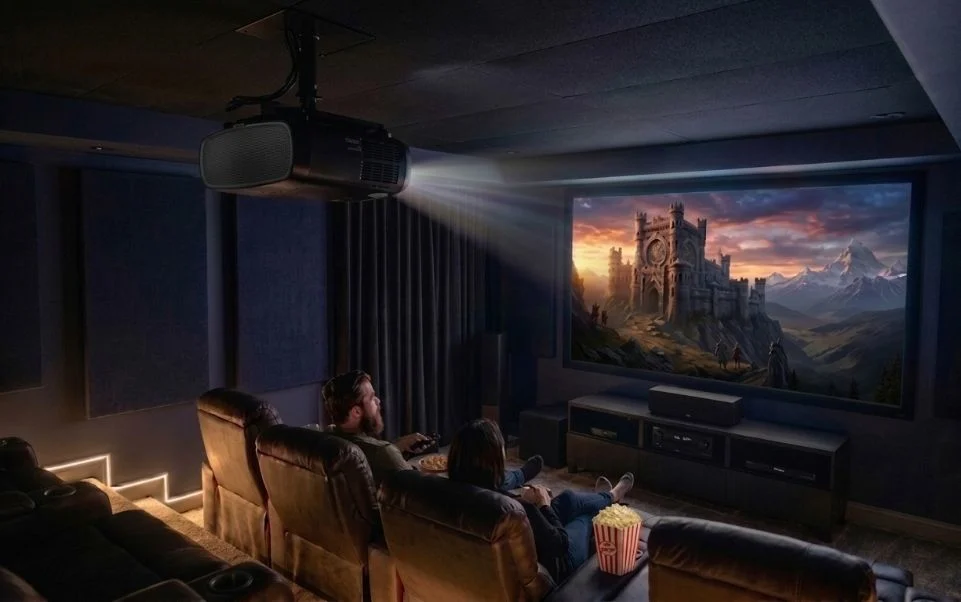
How to Choose the Best Projector for A Home Theater Room Setup

To select the best projector for home theater use, you must first measure your room dimensions and also determine the amount of natural light present. By matching the projector’s light output to your environment and also ensuring the throw distance fits your seating arrangement, you have to choose the right model. The right projector choice creates a clear, large image that stays bright even if the room is not perfectly dark. It is about finding a balance between the physical space as well as the technical capabilities of the hardware.
Factors to Consider While Choosing Projector
Selecting a projector for your home cinema involves more than just looking at the price tag. You need to think about how the light behaves in your room and also how far back you can place the unit. Every home cinema installation is different, so what works for another might not work for your space.
Throw Distance & Room Size
The throw distance is the measurement between the projector lens and also the screen. Some models need several metres to create a large image, while others can sit just centimetres away from the wall. If you are working with a best home theater room design that is long and narrow, a standard throw projector works well. However, in smaller rooms, you might need a short-throw model to prevent people from walking in front of the beam. You should always check the manufacturer’s throw ratio before you buy to ensure the image fits your screen size from its intended mounting spot.
Colour Technology
Most modern projectors use one of three main technologies to create colours, such as DLP, LCD, or LCoS. DLP models are known for being compact and having smooth motion, which is great for sports. LCD projectors usually offer better colour saturation and run a bit quieter, and LCoS is a premium option that combines the benefits of both, that offer deep blacks and very high image quality. Each technology handles light differently, so your choice depends on whether you value brightness or colour depth more.
Resolution
Resolution refers to the number of pixels that make up the image, and a higher number of pixels results in a sharper and more detailed picture.
While 1080p used to be the standard, 4K is now the preferred choice for the best projector for home theater experience. A 4K image is four times as detailed as a standard high-definition one, and this makes it much more realistic on very large screens.
Contrast
Contrast is the difference between the brightest whites and the darkest blacks that a projector can produce. High contrast is very important because it gives the image depth and makes it look three-dimensional. If a projector has poor contrast, dark scenes in movies will look muddy and also grey. This is mainly important if you plan to watch films in a completely dark room where every detail in the shadows becomes visible.
Light Output & Brightness
Brightness is measured in lumens, and if you have a dedicated room with no windows, you do not need a very high lumen count. However, for a home cinema installation in a living room with some ambient light, you will need a brighter bulb to prevent the image from looking washed out.
Input Source
Think about what you will plug into your projector, and most people use gaming consoles, Blu-ray players, or streaming sticks. You should look for a device with at least two HDMI ports, and if you plan to play video games, check the input lag. A lower lag means the action on the screen happens as soon as you press a button on your controller, which is vital for fast-paced gaming.
Ease of Installation & Setup
Some projectors are easier to install than others, and features like lens shift and keystone correction allow you to adjust the image without moving the entire unit. Keystone correction is a digital adjustment that helps if the projector is sitting at an angle, though it can slightly reduce the sharpness of the image.
If you are looking for expert help in setting up your space, we can help you create the perfect cinematic environment. Trusted home theatre dealers in Kerala will help you choose the best in every area, like the display, sound, seating, etc. From choosing the right screen to installing the best projector for home theater for your specific layout, Climax Cinemas handle the details so you can enjoy the films.
Common Projector Buying Mistakes
Buying too much brightness
People frequently think that more lumens are always better, but remember that if your room is pitch black, a projector that is too bright can cause eye strain.
Ignoring the throw ratio
Many people do this, and it is a mistake to buy a projector before measuring your room. If you buy a projector without having a proper idea about the room size, you might find that the image is either too small for your screen or too large to fit on your wall.
Forgetting about the screen
Many people spend their entire budget on the projector and then use a white bedsheet or a plain wall. Always remember that a proper screen reflects light better and improves the quality of the image.
Frequently Asked Questions (FAQs)
Q1: How long do projector bulbs actually last before they need to be replaced?
A1: Most standard projectors last between 5,000 and 15,000 hours, and if you use your home cinema for about two hours every single day, the bulb should last you roughly 4 to 6 years before you notice the light starting to dim.
Q2: Can I use a projector in a room with windows and natural sunlight?
A2: Yes, you can use a projector in a room with windows, but you will need a model with a high lumen count, usually above 3,000 lumens, to compete with the sunlight. It also helps to use a light-rejecting screen, which is designed to reflect only the light coming from the projector while ignoring the light from the windows.