
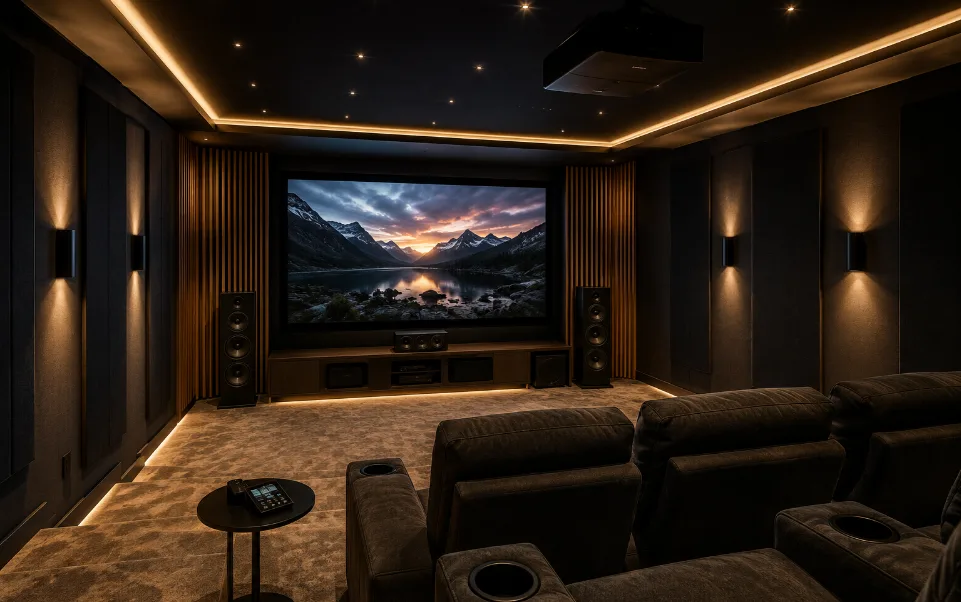
Is a Home Theater Worth the Investment? What to Plan Before Building Your Dream Home

Yes, a home theater is worth the investment, provided the planning happens at the right time. That single point makes the biggest difference between a room that sounds and feels like a proper cinema and one that ends up as an expensive disappointment. The timing matters more than the budget, and that’s the first thing worth understanding before you go any further.
Why Timing Changes Everything
Most homeowners think about a home theater once the house is already built, sometimes even after the family has moved in. Any change at that stage costs more and often delivers less.
The better approach is to bring a home theater into the conversation while the house is still on the drawing board. At Climax Cinemas, this is something we tell clients repeatedly: get us involved during the blueprint stage, not after the plaster has dried. When structural design and cinematic requirements are considered together from day one, the room ends up working with the house rather than being squeezed into whatever space is left over.
What Early Planning Actually Prevents
- Breaking open finished walls to add wiring or acoustic panels
- Discovering too late that a door sits in the wrong place for sound isolation
- Paying twice, once for the build and again for the fix
Home Theater Design Starts With Room Shape
Good home theater design isn’t just about the screen size or the number of speakers you buy. It starts with the shape and proportions of the room itself. A square room, or one where the dimensions are simple multiples of each other, tends to create uneven bass and awkward echoes no matter how good the equipment inside it is.
One commonly used approach is to design the room using well-established acoustic room proportions, which help reduce standing waves and create a more balanced listening environment. Rooms built with these proportions in mind tend to avoid the standing waves and muddy bass that plague oddly shaped spaces, giving a more natural and balanced listening experience without needing excessive acoustic treatment to fix it afterwards.
Door Positioning Matters More Than People Expect
Where a door sits in a home theater room affects two things at once: sound leakage and speaker placement. A door positioned badly can let sound escape into the rest of the house, and it can also block where a speaker ideally needs to sit for balanced audio. Getting this right early avoids having to compromise on speaker positions later simply because a door is in the way.
Some of the Best Home Theater Room Design Ideas Come From Getting the Basics Right
When people search for the best home theater room design ideas, they usually expect a list of fancy finishes or seating layouts. In reality, the ideas that make the biggest difference are the basic ones: room proportions, door placement, wall material choices, and where electrical points sit before the walls are closed up.
- Choose wall materials with soundproofing in mind, not just appearance
- Mark out electrical and cabling points before construction begins, not after
- Avoid perfectly square rooms wherever the floor plan allows it
Home Theater Setup and Installation: What to Expect
Once the structural groundwork is right, the home theater setup itself becomes far simpler. Acoustic planning should happen before construction starts, not once the room is already built, because retrofitting soundproofing into finished walls is both disruptive and expensive.
Home theater installation at this stage involves fitting the actual equipment, calibrating sound, and confirming that speaker placement matches the acoustic plan drawn up earlier. When the groundwork has been done properly, installation tends to go smoothly, without last minute changes to compensate for a room that wasn’t designed with sound in mind.
What Does Home Theatre Setup Cost Actually Depend On?
A common question we hear is about home theatre setup cost, and the honest answer is that it depends far more on planning than on how much you’re willing to spend. A high quality home theater can be built on a modest budget, provided decisions around room shape, door placement and acoustics are made early. Poor planning, on the other hand, tends to push costs up regardless of budget, simply because mistakes made in the early stages become expensive to correct later.
Reframing the Investment
It helps to think of a home theater less as a single expense and more as something built for the years your family will actually spend using it. A well planned room becomes part of everyday life, not just a space reserved for special occasions. That shift in thinking, from cost to investment, tends to change how people approach the planning process altogether.
Getting Started the Right Way
At Climax Cinemas, we offer a free initial consultation to help you understand what your specific space and requirements actually need, before any construction decisions are locked in. Climax Cinemas prefer working directly with homeowners rather than through third parties, since that keeps the original vision for the room intact from planning through to installation.
If you are planning a new build or considering a home theater as part of your dream home, get in touch with us at Climax Cinemas before your blueprints are finalised.
Frequently Asked Questions (FAQs)
Q1: Is a home theater worth the investment if I'm on a tight budget?
A1: Yes, a home theater can still be worth the investment on a smaller budget, as long as the planning is done properly from the start.
Q2: When should I start planning my home theater?
A2: Ideally during the house construction phase, while the blueprints are still being finalised, so structural and acoustic requirements can be built in rather than added afterwards.
Q3: Does the shape of the room really affect sound quality that much?
A3: Yes. Square rooms or rooms with simple repeating dimensions tend to create uneven bass and echo, while proportioned rooms following principles distribute sound more evenly across the space.