
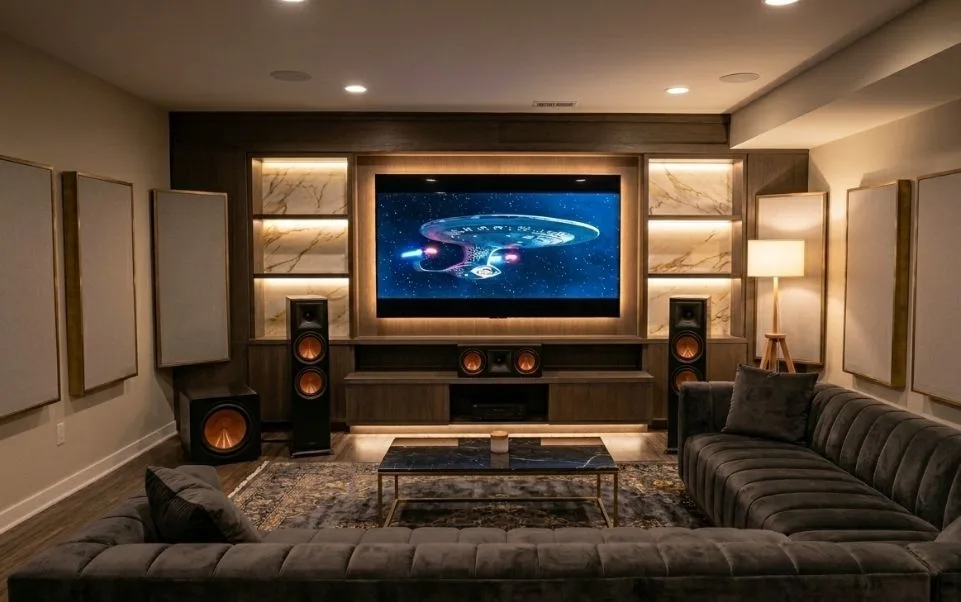
Home Theater Speaker Placement in Living Room: Get Cinema Sound at Home

To get the best audio, the right speaker placement in living room layouts starts by putting the centre speaker directly at ear height and arranging the front left and right speakers in a triangle with your sofa. You should also put surround speakers slightly behind you on the sides and find a corner or a wall spot for the subwoofer where the bass feels punchy rather than boomy. At Climax Cinemas, we help people transform their basic lounges into immersive spaces.Many
homeowners spend plenty of money on high-end gear but feel let down by the results. Usually, the issue is not the equipment itself, and it is how the speakers are placed in the room.
Speaker Placement
The way sound moves in a room depends on where it starts. Hard floors, glass windows, and even your sofa fabric change how waves bounce around. When we think about home theater speaker placement in living room environments, we have to consider that these are multi-purpose spaces. You use them for talking, drinking tea, and relaxing. We want the sound to be great without making the room impossible to live in. Proper positioning ensures that every explosion, whisper, or musical note reaches your ears at the correct time. If speakers are too close to walls, the sound might get muddy. If they are too far apart, you lose the sense of a continuous soundstage.
Center Channel
The centre speaker is arguably the hardest worker in your home theater speaker setup. It handles almost all the dialogue and a good chunk of the on-screen action. You should place it directly above or below your television. The most important thing is to aim it toward your ears. If it sits on a low shelf, tilt it upwards. If it is high up, tilt it down. We see many people hide this speaker inside a cabinet, but that usually makes voices sound like they are coming from a box. Try to keep the front of the speaker flush with the edge of the furniture to prevent sound from bouncing off the shelf surface.
Front Left & Right
These two speakers create the width of your movie experience. For a standard living room home theater design, you should place them at an equal distance from the screen. Ideally, they should form an equilateral triangle with your main seat. This means if you are sitting three metres away from the TV, the left and right speakers should also be about three metres apart from each other.
Surround Speakers
Surround speakers are meant to provide atmosphere, and in a 5.1 system, these should not be behind you. Instead, place them to the left and right of your seating area, perhaps just a few inches behind the line of your ears. They should be a bit higher than your head when you are sitting down. This prevents the sound from being blocked by the back of the sofa or other people sitting next to you. If you have a 7.1 system, you add two more speakers directly behind you. For most speaker placement in living room projects, keeping things simple with a 5.1 layout often works best because it avoids clutter.
Subwoofer
The subwoofer is the heavy lifter for bass. Unlike other speakers, bass is non-directional, meaning your ears find it hard to tell exactly where it is coming from. However, the room has a huge impact on how bass feels. We recommend the subwoofer crawl method. You place the subwoofer in your seat, play a bass-heavy song, and then crawl around the room on your knees to hear where the bass sounds the cleanest. Usually, placing it near a corner makes the bass louder, but putting it away from the walls makes it tighter and more accurate.
Height Speakers
If you are going for a modern Dolby Atmos setup, you will need height speakers. These make it sound like a helicopter is actually flying over your roof. You can either install speakers in the ceiling or use up-firing speakers that sit on top of your front towers, and ceiling speakers are better, but they require more work for a home cinema installation. Up-firing speakers bounce sound off the ceiling and back down to you, and this works best if your ceiling is flat and made of a hard material like plaster.
Planning a room layout requires some thought about cables and furniture. If you are starting from scratch, think about how the wires will run. If you are worried about the technical side, we are here to help. We provide expert advice to ensure your hardware performs at its peak.
Creating a cinema experience at home is about more than just buying the most expensive boxes. It is about how those boxes talk to each other in your specific space. By following these simple rules for placement, you can make a mid-range system sound like a professional theatre. If you want the best home theater sound experience, get in touch with Climax Cinemas.
Frequently Asked Questions (FAQs)
Q1: What is the typical home theatre setup cost?
A1: The price can vary wildly based on the quality of the speakers and the amplifier. A decent entry-level system might start around ₹65,000, but high-end setups can easily go over 6 lakhs. It depends on whether you want a basic 5.1 system or a full Atmos experience with a projector.
Q2: What is the home theatre setup cost in India for a standard room?
A2: In India, a good quality branded home theatre system usually starts from approximately ₹60,000 and can go up to several lakhs for custom installations. This price usually includes a receiver, five speakers, and a subwoofer, though wiring and professional calibration might add to the total.
Q3: Can I put my speakers inside a bookshelf?
A3: You can, but it is not the best for sound quality. Bookshelves often cause the bass to boom and can distort the mids. If you must put them in a shelf, try to fill the empty gaps around the speaker with acoustic foam or books to stop unwanted vibrations.