
Home Theater Projector vs TV: Which Offers the Best Movie Experience?

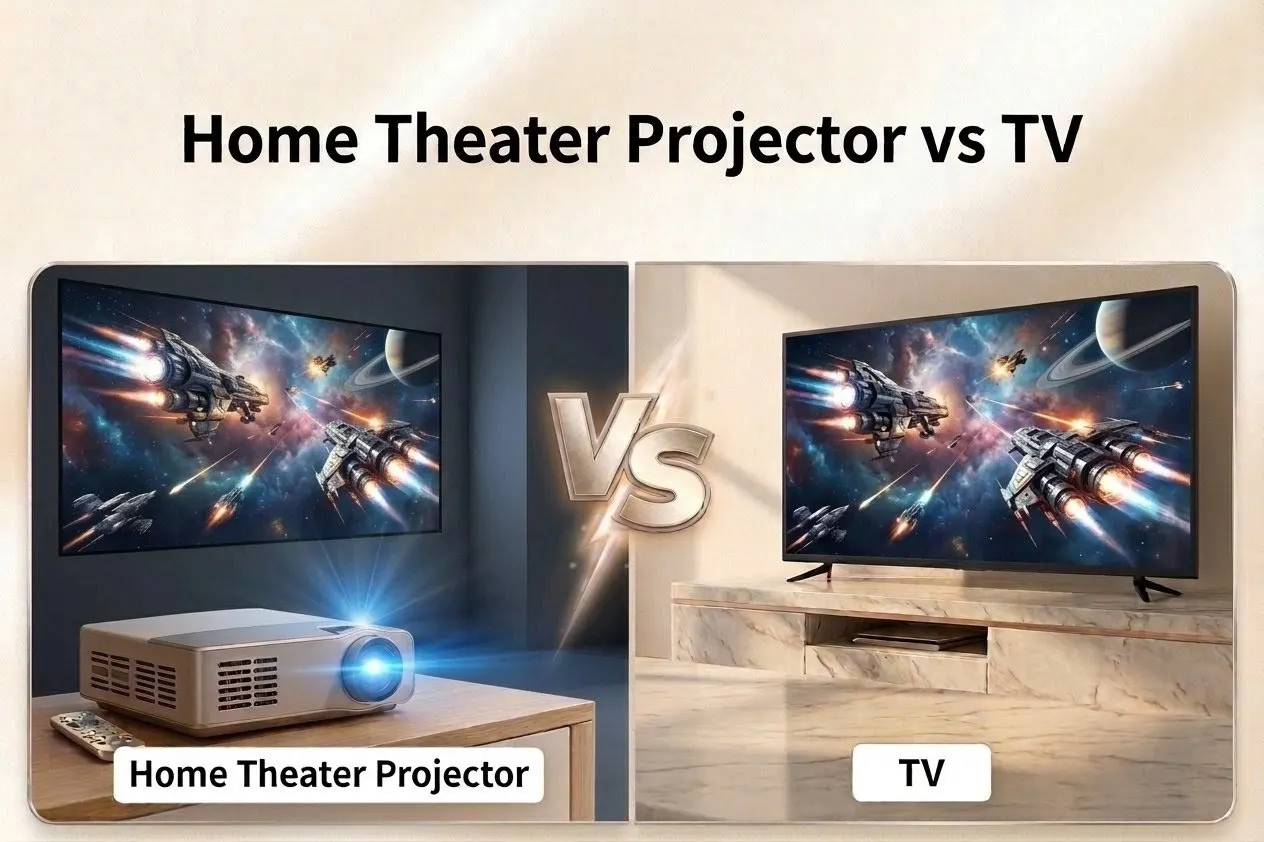
For most people, a home theater projector vs TV decision comes down to one thing: screen size. A projector is better in size, whereas a TV handles bright rooms without any fuss, keeps things simple, and does not need anything particular of the space it sits in. The right choice depends on your space, your budget, and how seriously you want to commit to the movie-watching experience at home.
The Main Difference: Home Theater Projector vs TV
A TV is a single, self-contained unit. The screen, speakers, media player, and smart platform, whether that is Android TV, webOS, or something else, are all built in. You plug the TV in, connect it to the internet, and it works, and that convenience is genuinely valuable.
A projector works differently. The image is projected onto a surface rather than displayed directly, which is what allows for much larger screen sizes. But to make it function properly, you usually need the projector itself, a separate media player or streaming device, and a dedicated sound system, either a soundbar or a full AV receiver with speakers. Each of those is an additional cost and an additional thing to set up. So while the screen can be vastly bigger, the overall home theater system is more involved as well.
| Feature | Home Theater Projector | Television |
|---|---|---|
| Screen size | 100 inches and beyond | Typically 40 to 85 inches for most homes |
| Setup complexity | Requires multiple components | All-in-one, minimal setup |
| Room lighting | Works best in a dark or controlled-light room | Handles ambient light well |
| Sound system | External speakers or AV receiver needed | Built-in speakers included |
| Cost | Higher when all components are included | More predictable, fixed cost |
| Eye comfort (long sessions) | Many viewers find projected images easier on the eyes in dark rooms | Brighter self-emitting display, may cause more fatigue over time |
| Best suited for | Dedicated home cinema rooms | Living rooms, bedrooms, multi-use spaces |
Does Screen Size Actually Matter for the Experience
A large projected image pulls you into the film in a way that is hard to replicate on a smaller screen. The wider the image fills your line of sight, the more your brain stops being aware of the room around you. That is the quality a home cinema projector shares with a real cinema screen, and it is why dedicated setups tend to feel different to simply watching a TV, even a good one.
A large-format TV in the 85 to 100-inch range can still form the centrepiece of a solid home theater setup, though. Some people build their home theaters entirely around a large-screen TV rather than a projector, and depending on the room and the use case, that can work very well.
What About Eye Strain?
This comes up a lot, and the honest answer is that it depends on more than just the type of display. A projected image is not self-emitting, meaning the light comes from a surface rather than directly from the screen itself. In a properly darkened room, many people find this easier to watch for long periods compared to a bright TV display.
But eye strain from any screen is affected by brightness levels, viewing distance, room lighting, and the quality of the equipment. A poorly set-up projector in a half-lit room can be harder on the eyes than a well-calibrated TV watched at the right distance.
When Projector is Needed
Choose dedicated home cinema projector when:
- You have a dedicated room with controllable lighting
- You want home theater screen size above 100 inches
- You are building a full home theater with a separate sound system
- Long movie sessions are the primary use case
When TV is Needed
A television is likely the better fit when:
- The room is used for multiple purposes and cannot always be darkened
- You want a simpler setup with fewer components to manage
- Budget is fixed and as an all-in-one solution, TV is more practical
- The viewing distance is relatively short
Best Projector for Home Theater Setup
As your budget increases, your options open up considerably. Entry-level projectors can produce a large image, but image quality and brightness improve significantly as you move up the price range. The best projector for home theater use should ideally offer good brightness for your room size, a sharp enough image at the screen size you are targeting, and low input lag if you plan to use it for gaming as well.
A proper home theater installation also means thinking about where the projector mounts, how cables are routed, and how the sound system integrates with everything else.
How Climax Cinemas Can Help
At Climax Cinemas, we handle everything from home theater design through to full installation. Whether you are leaning toward a projector setup or a large-screen TV arrangement, we help you work out what actually fits your room, your budget, and how you use the space.
Get in touch with Climax Cinemas to speak with our team about your home theater project.
Frequently Asked Questions (FAQs)
Q1: Is a projector always better than a TV for a home theater?
A1: Not always. A projector gives you a larger screen, but it works best in a room where you can control the lighting. A TV is simpler to set up and handles brighter rooms better.
Q2: Do I need a separate sound system if I use a projector?
A2: Yes. You need a separate sound system if you use a projector as different from a TV, a projector does not have built-in speakers that are good enough for a proper home theater experience. You will need either a soundbar or a full AV receiver with speakers, which adds to the overall cost but also gives you much better audio quality than any built-in TV speaker.