
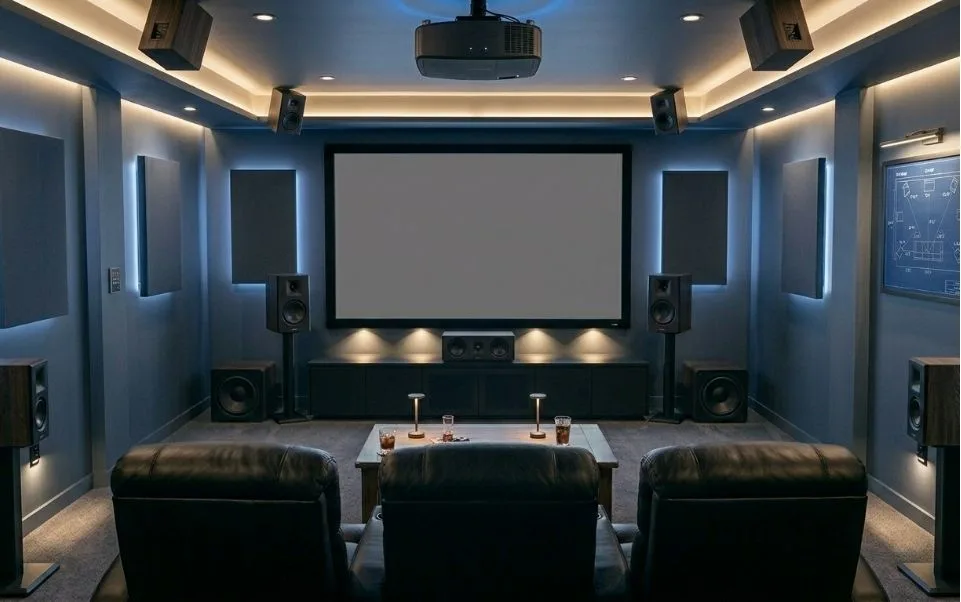
What is Home Theater Configuration? Types, Uses

What is home theater configuration is the strategic arrangement and also specific numbering of speakers, subwoofers, as well as audio channels within a room to recreate a cinema-like listening experience.
When you look at a set of numbers like 5.1 or 7.1.4, you are seeing the home theater speaker configuration in its most basic form, and the first digit represents the number of traditional speakers at ear level. The second digit indicates the number of subwoofers for low-frequency effects, also if there is a third digit, it refers to the height or ceiling speakers used for three-dimensional sound.
Home Theater Configuration
A home theater speaker configuration serves as the blueprint for your entire audio environment, and it is not just about buying expensive equipment but about placing it in a way that reflects how sound travels. Sound waves bounce off walls as well as furniture, so the configuration must account for these reflections to ensure that dialogue remains clear, along with action sequences feel impactful.
Home Theater Configuration Types
There are several home theater setup types available, and these range from simple two-speaker setups to complex arrangements that involve speakers installed directly into the ceiling.
Basic Home Theater Configurations
Most people use these as their entry point to the network, and they are affordable and easy to set up, and they don’t need much space or wiring to set them up.
- 2.0 System
-2 front speakers
-No subwoofer
-Suitable for music and basic TV viewing - 2.1 System
-2 speakers + 1 subwoofer
-Adds deeper bass for movies and gaming
-Ideal for small rooms - 3.1 System
-Left, centre, and right speakers + 1 subwoofer
-Improves dialogue clarity
Good for movie streaming and sports
Surround Sound Configurations
In a surround sound configuration, speakers are usually placed either behind or to the side of the listener, giving the impression that sound is coming from every direction in the room as the sound is coming from everywhere.
- 5.1 Home Theater System
-5 speakers + 1 subwoofer
-Most popular setup for home cinema
-Includes rear surround speakers - 7.1 Home Theater System
-7 speakers + 1 subwoofer
-Adds extra rear speakers
-More immersive surround sound
Dolby Atmos Configurations
The Dolby Atmos technology is a new advancement in audio technology that adds an additional layer of depth to the audio experience, and instead of sound just moving left, right and back, it now moves up and down as well. In order to achieve Dolby Atmos, either speakers are mounted in the ceiling or upward-firing speakers are used to bounce the sound off the ceiling and into the room.
- 5.1.2 System
-1 subwoofer + 5 speakers + 2 height speakers
-Entry-level Dolby Atmos setup - 7.1.2 System
-7 speakers + 1 subwoofer + 2 height speakers
-Better surround and overhead effects - 7.1.4 System
-1 subwoofer + 7 speakers + 4 ceiling speakers
-Premium cinematic experience
Home Theater Configuration Uses
Knowing what is home theater configuration is very important, and you also need to understand how these different layouts serve different purposes in your daily life.
- Creating an Immersive Movie Experience
- Improving Audio Quality for Music
- Improving Gaming Experience
- Optimising Sound Based on Room Size
- Supporting Advanced Audio Technologies
Whether you want a hidden system that blends into your decor or a bold, professional-grade cinema room, the configuration is where the journey starts.
If you are ready to take the next step in your home entertainment journey, we at Climax Cinemas can assist you with all the steps you need to take. You can find more information about our services and how we can help you design the perfect layout by contacting Climax Cinemas.
Frequently Asked Questions (FAQs)
Q1: What is the best configuration for a small room?
A1: For a smaller space, a 2.1 or 3.1 system is usually the most effective choice, also these setups provide an important upgrade over standard television speakers without requiring a lot of floor space or complex wiring. A 3.1 system is usually good if you struggle to hear dialogue clearly, as the dedicated centre channel keeps voices crisp even in tight quarters.
Q2: Do I really need ceiling speakers for Dolby Atmos?
A2: While in-ceiling speakers provide the most authentic Atmos experience, they are not the only option, and you can use upward-firing speakers that sit on top of your existing front speakers and bounce sound off the ceiling to your ears.