
Why Your Room Echoes (And How Acoustic Treatment Solves It Easily)

Your room echoes because sound waves are bouncing off hard, flat surfaces like walls, ceilings, and floors instead of being absorbed, and you can solve this by installing acoustic room treatment. When a sound is made in an empty or poorly furnished room, it travels until it hits a solid object. If that object is hard, the sound energy reflects back into the space, creating a repetitive noise known as a flutter echo or reverberation. By managing these sound reflections, you can turn a noisy, rattling room into a space that sounds clear and professional.
What are the Common Causes for Room Echoes?
Before we look at the solutions, it helps to understand why the echo in home theater room settings happens in the first place. Sound behaves much like a rubber ball thrown against a wall, and the harder the surface, the faster and more directly the ball bounces back.
Low-Frequency Build-up
Bass notes are long and also carry a massive amount of energy as well. In many rooms, these low frequencies tend to gather in the corners and along the edges of the ceiling. When bass waves collide, they can either cancel each other out or create a boomy, muddy sound that hides the finer details of a film soundtrack. This build-up makes it hard to hear clear speech because the low-end noise is physically masking the higher frequencies.
Room Geometry
It is important to note that the shape of your room plays a large role in how sound behaves. Perfectly square rooms are generally the most difficult to manage because the parallel walls allow sound to bounce back and forth in a constant loop. This creates standing waves, where certain notes sound much louder or quieter depending on where you are sitting.
For a high-quality mini home theatre design, we usually prefer rectangular spaces that help break up these direct paths.
Hard Surfaces
Modern home design frequently features large glass windows, hardwood floors, as well as plastered walls. While these look beautiful, please understand that they are terrible for acoustics. A standard plastered wall can reflect roughly 98% of the sound energy that hits it, and this leaves only a tiny fraction of the sound to be absorbed by the structure, meaning the rest stays in the room as an annoying echo.
How to Fix Room Echoes?
The goal of a well-treated room is to balance the sound so it feels natural, and you do not want a room that is completely dead, as that can feel unnatural to sit in. Instead of that, you want to use acoustic room treatment to tame the reflections that confuse.
Strategic Absorption
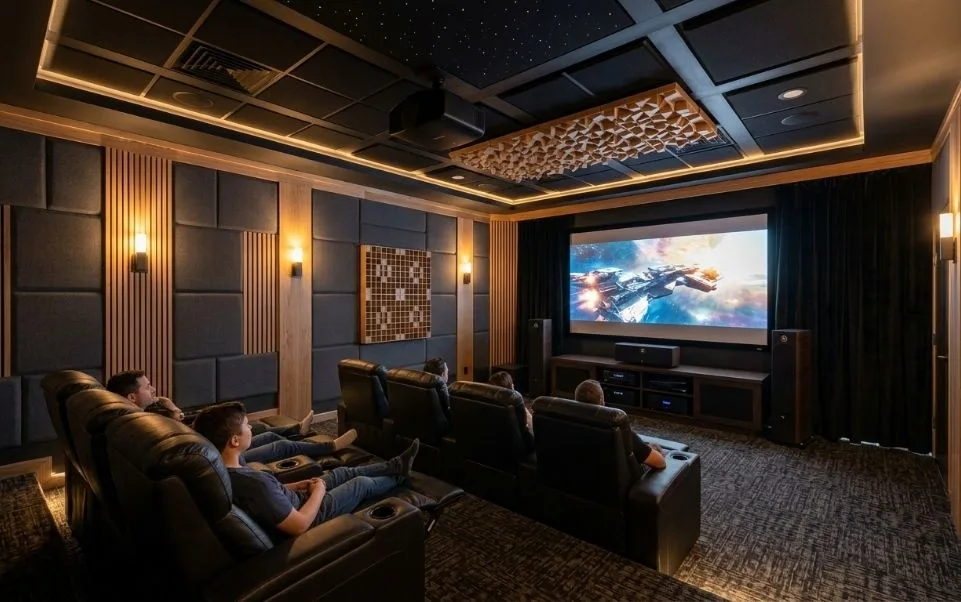
Absorption is the most direct way to stop an echo, and this involves placing soft materials at the first reflection points. These are the spots on your side walls where the sound from your speakers hits first, and by placing fabric-wrapped foam or mineral wool panels here, you soak up the energy before it has a chance to bounce back toward your ears.
Diffusers
If you absorb every single sound wave, the home theater room can feel small as well as suffocating. Diffusers are tools that have uneven surfaces designed to scatter sound in different directions, and instead of the sound bouncing back in one straight line, it is broken up into many smaller, weaker waves. And this way, with the usage of diffusers, it is possible to maintain the liveliness of the room while removing the harshness of the echo.
Bass Traps
Because bass builds up in corners, we use thick, dense panels called bass traps, and these are usually placed in the vertical corners of the room from floor to ceiling. They are much thicker than standard wall panels because low-frequency waves are physically larger and require more mass to stop. Please note that this is a very important part of any home theater acoustic treatment plan.
Walls & Ceilings Treatment
The ceiling is the largest flat surface in most rooms, yet it is regularly ignored most of the time. Adding clouds, which are acoustic panels suspended from the ceiling, can drastically improve the clarity of your audio. On the walls, we suggest a mix of absorption as well as diffusion to ensure the sound stays balanced across the entire seating area.
Optimise Floors
If you have tile or wood floors, the quickest fix is a thick rug with a heavy pad underneath, and this addresses the vertical reflections between the floor and the ceiling. While it might not be as effective as professional panels, it provides a necessary layer of damping that helps reduce the overall noise floor of the room.
Use Furniture & Decor
A large, plush fabric sofa acts as a natural absorber, and sometimes bookshelves filled with books of varying sizes act as a makeshift diffuser! Interestingly, even heavy curtains over windows can help block the reflections coming off the glass and reduce room echoes.
Soundproofing vs. Acoustic Treatment
It is a common mistake of many people to use these terms as if they mean the same thing. However, it is important to understand that soundproofing vs acoustic treatment involves two very different goals.
Soundproofing
Soundproofing is about isolation, and it stops sound from leaking out of the room to keep the neighbours happy, or it stops outside noise like traffic from coming in. This requires adding heavy mass to the walls and also sealing all air gaps as well.
Acoustic Treatment
When it comes to acoustic treatment, it is about the quality of sound inside the room, and you can have a perfectly soundproofed room that still sounds terrible because of echoes. We focus on treatment to ensure that when you watch a movie, every whisper and every explosion sounds exactly as it should be.
Importance of Acoustic Treatment in Fixing Room Echoes
Remember that without proper acoustic treatment, even the most expensive speakers in your home theater will perform poorly. In fact, a modest sound system in a well-treated room will almost always sound better than a high-end system in a room full of echoes. Achieving this balance is very essential for speech intelligibility, and if the echo is too high, the dialogue will blur together, forcing you to turn up the volume, which only makes the echo worse.
Conclusion
An echoing room is a barrier to enjoying home cinema, and by understanding that hard surfaces are the main enemy, you can begin to take steps to refine your environment. Whether you are starting from scratch with the best home theater room design or simply trying to fix a noisy living room, the right balance of absorption and diffusion will make a difference. We at Climax Cinemas are here to install acoustic materials and audio equipment for the perfect audio experience. Never underestimate the importance of effective acoustic room treatment, which is the bridge between a simple room and a true cinematic experience.
Frequently Asked Questions (FAQs)
Q1: Where is the best place to put acoustic panels?
A1: You should start by placing acoustic panels on the side walls exactly halfway between your seating position and your speakers. This area is called the first reflection point and is the most common source of harsh echoes.
Q2: Does acoustic treatment make the room quieter?
A2: It makes the room feel quieter in terms of reflections, but it does not stop noise from outside. It makes the internal sound more controlled and also clearer by reducing the time it takes for a noise to fade away.