
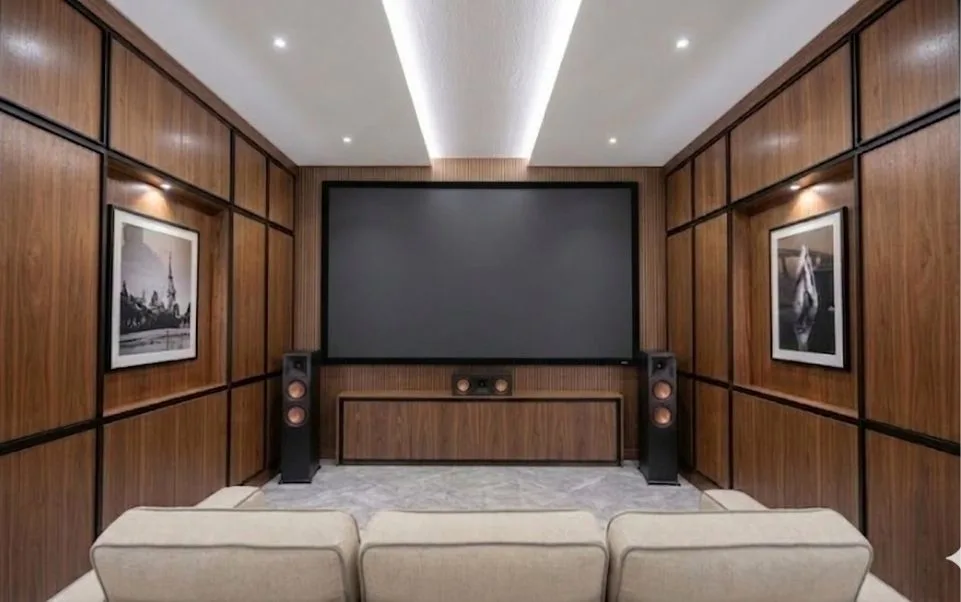
Best Sound System for Home Theater: Complete Setup & Buying Guide

The best sound system for home theater is one that balances high-quality hardware with proper speaker placement customised to your specific room. We frequently see people buy the most expensive speakers on the market, expecting an instant cinema experience, but this is a mistake. While build quality and high-end internal components are helpful, they do not guarantee great audio if the installation is handled poorly.
When we talk about a high-quality home theater setup, we are looking for a sense of immersion, right? If you place your speakers in the wrong spots, this effect disappears. Instead of hearing a smooth transition, the sound might just jump from one side to another or feel like it is coming from nowhere in particular. Misplaced equipment leads to a muddled mess where different frequencies clash, making the final result quite disappointing.
Factors to Consider While Placing Speakers
Getting the most out of your investment in speakers requires looking at the physical layout of your room. The following are some of the main areas we focus on during home theater speaker placement.
1.Ear Height Levels
For the clearest dialogue and sound effects, the tweeters of your front speakers should be at the same level as your ears when you are sitting down. If the speakers are too high or too low, you lose the clarity of high-frequency sounds. We always suggest measuring the height of your seating before mounting any gear on the walls for the installation.
2.Speaker Angles
The front left and right speakers should not just point straight ahead, and they need to be angled slightly towards the main seating area. This creates a sweet spot where the audio feels balanced, and if the angles are off, the soundstage feels narrow as well as flat.
3.Distance from the Listening Position
For the best sound experience, everyone in the room should ideally be at an equal distance from the left and right speakers. If you sit too close to one side, that speaker will dominate the audio, ruining the stereo image. We use calibration tools to ensure that the timing of the sound reaching your ears is perfectly synced.
4.Room Size & Layout
When compared to a large open-plan living area, a small spare bedroom needs a different approach. In South India, many homes feature hard tiled floors and also high ceilings, which can cause sound to bounce around
Before calibration and installation, we always look at the room dimensions first to decide if you need compact bookshelf speakers or large floor-standing towers.
5.Surround Sound Positioning
Surround speakers are meant to provide ambient noise as well as atmospheric effects. Speakers should be placed to the sides of the seating area, slightly behind the listeners, and if you put them right in the corners of the room, the sound becomes too detached from the action on the screen.
6.Subwoofer Placement
Finding the right spot for a subwoofer is tricky because bass waves are long and can build up in certain parts of a room. This leads to boomy bass that lacks detail, and we recommend the subwoofer crawl method, where you place the sub in your seating spot and move around the room to hear where the bass sounds the cleanest.
7.Wall Distance & Reflections
Placing speakers directly against a wall can cause the bass to become muddy. Giving your speakers some breathing room, even just a few inches, allows the sound to expand naturally. We also look for points where sound might reflect off windows or bare walls and suggest ways to dampen those reflections.
8.Speaker Alignment (Left, Centre, Right)
The centre channel is the most important speaker for movies because it carries almost all the dialogue. It must be perfectly aligned with the middle of your screen. If you are planning a home theater setup in South India, we often recommend placing the centre speaker at a slight tilt if it is sitting on a low cabinet, so the voices are directed towards your head rather than your knees.
9.Acoustic Treatment
Even the best sound system for home theater can sound poor in a room with too many echoes. Using thick curtains, rugs, or specialised foam panels helps soak up extra noise, and this prevents the sound from ringing, and makes every word spoken on screen much easier to understand.
10.Speaker Type & Configuration
Whether you choose a 5.1, 7.1, or a 5.1.2 Atmos system depends on your budget and also space. We help you choose the configuration that fits your lifestyle. Sometimes a simpler system that is well-placed will sound better than a complex one that is crammed into a tiny room.
Conclusion
It is important to understand that buying a high-priced speaker does not always mean you will get the best audio experience or performance. What truly matters is choosing the right equipment for your specific space and, more importantly, how you set it up. Even the best sound system for home theater will only sound average if the layout is wrong.
Great audio involves careful tuning and also creating an environment where sound can travel exactly as the director intended. At Climax Cinemas, we focus on these details to make sure your home movies sound as good as a professional cinema.
If you are ready to transform your living space into a private cinema, we are here to help you. Get in touch with Climax Cinemas to find more information about our services and expert installation.
Frequently Asked Questions
Q1: Why does my home theater sound muffled?
A1: Home theatre sound is usually muffled because speakers are placed too close to walls or inside vibrating cabinets. It can also be caused by a lack of acoustic treatment, which allows sound waves to bounce off hard surfaces and clash with each other.
Q2: Where is the best place to put a subwoofer?
A2: There is no single best spot because every room is different. However, placing it near the front speakers but away from a direct corner is a good starting point to avoid overly boomy bass.
Q3: Do I really need ceiling speakers for Atmos?
A3: While ceiling speakers provide the most realistic overhead effects, you can also use up-firing speakers that bounce sound off your ceiling. This is a great alternative if you cannot cut holes in your ceiling for permanent installation.