
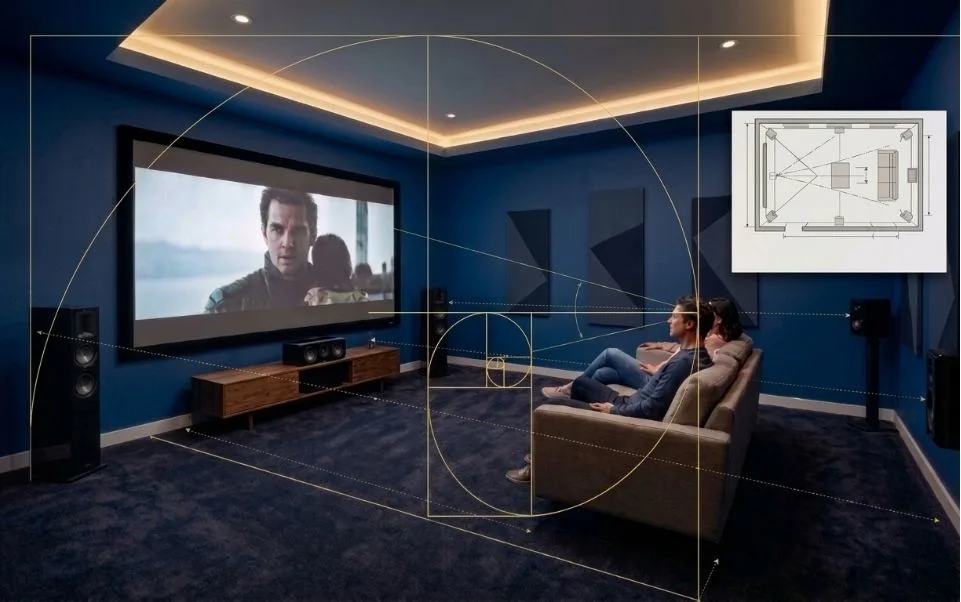
Golden Ratio for Home Theater

What is it that separates a decent home entertainment system from a truly breathtaking cinematic experience? We have all been in rooms with big screens and loud speakers that somehow still feel flat and not engaging. The sound might be muddy, or the picture just doesn’t pull you in. In order to create an environment that truly takes you into the world of a film, you do not just have to purchase the most expensive equipment and set up the best lighting.
It is interesting to note that one of the most powerful principles for achieving this perfect balance is not a modern technical formula, it is an ancient mathematical concept. The ratio has been found in nature, art, and architecture for millennia, and it is called the Golden Ratio.
Understanding how this principle applies to a modern home theater setup service is essential to experiencing a level of immersion you may not have thought possible within your home. It is the hidden architecture behind a perfect movie night.
Golden Ratio and Home Theater Setup
The Golden Ratio, approximately 1.618, is a number that describes a perfectly symmetrical relationship between two proportions. It’s a bit technical in theory, but it’s very simple to see in practice. It’s usually visualized as a rectangle that can be divided into a perfect square and a smaller rectangle that has the same proportions as the original. This pattern can be repeated into infinity, and creates a beautiful spiral.
You can see this beautiful proportion in many places, like the spiral of a seashell, the way trees branch out, and how flower petals are arranged. For centuries, artists and architects have used it. We find it appealing because our brains naturally enjoy the balance and harmony it brings. It just feels right.
Applying the Golden Ratio to Home Theater
So, how does a concept from art and nature relate to the technical world of audio and video? It connects to two main elements of your home theater: the size of the room and where you place screen and speakers. The way these elements are arranged can greatly affect your overall viewing as well as listening experience.
The Golden Ratio in Room Acoustics
The design of your room has a massive impact on how your sound system performs. A room with dimensions that are multiples of each other, like an exact cube or a room that is exactly twice as long as it is wide, is a sound nightmare. These symmetrical dimensions create something called “standing waves.” This is where sound waves reflect off parallel walls and either amplify or cancel each other out at certain frequencies, and this can lead to loud, indistinct bass and unclear dialogue.
The Golden Ratio provides a solution. By designing a room with dimensions that follow this ratio (for example, a room that is 1 unit high, 1.618 units wide, and 2.618 units long), you create a space with non-parallel, symmetrical proportions. This breaks up standing waves and results in clearer, tighter, and more accurate sound reproduction.
This principle also applies to speaker placement. For the best listening experience, the distance of the main speakers from the side walls and the back wall can be calculated using the Golden Ratio. This exact positioning minimizes early sound reflections that can blur audio imaging and results in a wide, deep, and clear soundstage.
Finding the Best Visual Spot
The Golden Ratio is also powerful in creating a visually immersive experience. It helps answer the two most common questions in any home theater setup: “How big should my screen be?” and “Where should I sit?”
There is a perfect viewing distance for any given screen size, a “best spot” where the screen fills your field of vision without being so close that you can see the individual pixels. Sit too far back, and the impact is lost. Sit too close, and the image becomes too big and artificial. The Golden Ratio helps you find this best visual spot with a simple formula:
Ideal Seating Distance = Screen’s Diagonal Measurement x 1.618
The ratio can also guide the vertical placement of the screen. To prevent neck strain and create a natural viewing angle, the screen should be positioned so that your eye level is about one-third of the way up from the bottom of the screen, a proportion that follows the Golden Ratio.
The Role of Professional Installation
However, in the real world, most of us work with existing rooms that are not perfect Golden Ratio rectangles. There might be a window in the wrong place, an improperly positioned door, or a too-low ceiling. This is where the theory ends, and the art of professional home cinema installation begins.
A professional home theater designer understands these basic principles. But their true expertise can be found in adapting them to your specific, unique space. They know how to use acoustic treatments, accurate speaker calibration, and clever layout strategies to overcome the limitations of an imperfect room and get as close to the acoustic and visual ideal as possible.
Conclusion
At Climax Cinemas, we believe that for an immersive home entertainment system, a deep understanding of technology and design is needed. We don’t just install speakers and screens, we engineer complete cinematic environments. Our design philosophy is built on these traditional principles of proportion and harmony. We use concepts like the Golden Ratio as a guide to create spaces that look and sound extraordinary.
Our process involves a complete analysis of your room’s dimensions and acoustic properties. From the screen and seating to the speakers and acoustic treatments, we design a system where every component is placed with the purpose of creating the most enjoyable experience possible.
Contact Climax Cinemas today to schedule a consultation and begin your journey toward the ultimate home theater experience.
Frequently Asked Questions (FAQs)
Q1: What is the golden rule for home theater?
A1: While there are many guidelines, the main “golden rule” for visual immersion is to use the Golden Ratio for your seating distance. A great starting point is to sit at a distance that is about 1.6 times the diagonal size of your screen.
Q2: Is 4:3 or 16:9 better for projectors?
A2: For a modern home theater, 16:9 is the definitive choice. The 4:3 aspect ratio is an older, more squarish format used for old television shows. 16:9 is the modern widescreen standard for almost all content you will watch, including HDTV, streaming services, and Blu-rays. Choosing a 16:9 projector and screen ensures the image will correctly fill the screen without black bars on the sides for most content.
Q3: What is the 38% rule in room acoustics?
A3: The 38% rule is a simple and effective guideline for finding the best listening position (the “sweet spot”) in a rectangular room. It suggests that your main seat should be placed 38% of the way into the room’s length, as measured from the front wall where your screen is.