
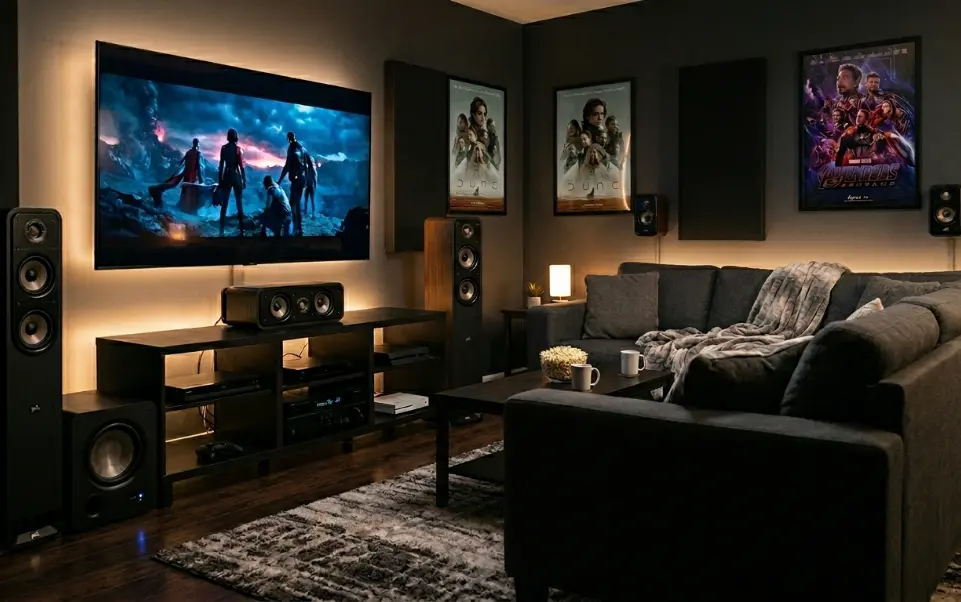
Why a 5.1 Home Theater System Is the Best Choice for Movie Lovers

A 5.1 home theater system is the best choice for movie lovers because it provides a true 360-degree soundscape that matches how most modern films are mixed. And yes, a 5.1 home theater system offers the right balance between high-end performance as well as practical setup requirements. Most standard Blu-ray discs and streaming platforms like Netflix or Disney+ are natively designed for five channels and a subwoofer, and this means a five-channel setup delivers the audio exactly as the director intended without the added complexity of more expensive systems.
What Makes Up This Audio Standard?
To understand why this specific layout works so well, we should look at what goes into the package, and a standard home theater setup using the 5.1 format consists of six main components.
- The centre channel, which is the most active speaker in your room. It sits directly above or below your screen and handles almost all the dialogue.
- The front left speakers, right speakers handle the music, sound effects, and also the sound movements across the screen
- The surround left and right speakers placed beside or slightly behind your seating area, and they provide the ambient noises that make you feel like you are inside the movie.
- The subwoofer handles the low frequencies that create physical vibrations during explosions or deep musical notes.
Fully Immersive Sound Experience
The main reason movie lovers gravitate towards this layout is the surround sound experience it creates. And when you watch a film with just your TV speakers, the sound is flat and comes from a single direction, and this pulls you out of the story.
When we install these home theater systems for our clients, the goal is to recreate a three-dimensional world. For example, if a car drives off-screen to the left, you will hear the engine noise fade from the centre to the left speaker and then eventually into the rear surround speaker. This movement of sound is what creates a sense of space and it allows your ears to tell your brain that you are in the middle of the action rather than just looking at a glass panel.
Versatility for Various Media
One of the strongest arguments for this configuration is how well it handles different types of content, and while we focus on movies, many people use their living rooms for gaming, listening to music, and watching live sports. As you can see, home theater systems that support 5.1 surround sound are very versatile in this regard.
5.1 vs 7.1 vs Dolby Atmos
When choosing a home cinema audio setup, you will likely hear about other configurations. People frequently ask about 5.1 vs 7.1 vs Dolby Atmos to see if they should spend more. A 7.1 system adds two more speakers behind you and while this sounds better on paper, many living rooms are not large enough to accommodate those extra speakers properly.
Dolby Atmos is another step up, adding height channels to simulate sounds coming from the ceiling. While Atmos is fantastic, it requires specific hardware and overhead speakers, which can be difficult to install in a finished home. For many, the 5 channel layout provides 90% of the benefit for a fraction of the work, and it remains the industry standard because it is compatible with almost every piece of media produced in the last thirty years.
Economical and Practical
Building a dedicated movie room setup can become very expensive if you start adding unnecessary channels, and each extra speaker requires more wire, a more powerful receiver, and more time for calibration.
By sticking to a 5.1 layout, you can spend your budget on higher-quality components rather than more components. It is far better to have five high-quality speakers and one great subwoofer than to have eleven mediocre speakers. Quality over quantity is a rule that we live by.
Powerful Bass & Depth
As you might know, the subwoofer is the main component of the 5.1 home theater system and a standard stereo setup, the small speakers usually struggle to produce low-frequency sounds. This results in a thin sound that lacks impact, and the dedicated subwoofer in a 5.1 kit takes the heavy lifting away from the smaller speakers.
A good bass response does more than just shake the floor during an explosion, and it adds weight to voices and richness to the musical score.
Clear Dialogues
Have you ever found yourself constantly turning the volume up during quiet talking scenes and then rushing to turn it down when the action starts? If yes, it is important to know that this usually happens because your speakers are trying to play voices and background music at the same time through the same driver.
A dedicated home theater setup solves this by using the centre channel, and in a 5.1 mix, the dialogue is sent almost exclusively to the centre speaker. And yes, this creates good audio clarity. As the voices are not competing with the loud music or sound effects coming from the left and right, it is possible for you to keep the volume at a comfortable level.
Best Choice for Home Theater Installation
When it comes to home theater installation, a 5.1 system is the best choice for ease and also effectiveness. Setting up surround sound speakers for home theater use requires some planning regarding wire runs and speaker angles. With five speakers, the wiring is relatively good, and you have three speakers at the front and two at the sides.
At Climax Cinemas, we have found that this layout is the easiest to calibrate for different room shapes. If you are thinking about 5.1 home theater system installation, get in touch with Climax Cinemas.
Frequently Asked Questions (FAQs)
Q1: What is the difference between a soundbar and a 5.1 system?
A1: A soundbar is a single unit that sits under your TV and tries to bounce sound off your walls to mimic surround sound. A 5.1 system uses five separate speakers placed around the room to create actual surround sound. This physical separation provides a much more realistic and immersive experience because the sound is actually coming from behind and beside you rather than just being reflected.
Q2: Do I need to buy a specific receiver for a 5.1 setup?
A2: Yes, you will need an Audio/Video Receiver (AVR) that supports at least five channels. The receiver acts as the brain of your system and it takes the signal from your TV or Blu-ray player, decodes the audio, also sends the right sounds to the right speakers. Most modern receivers come with five or seven channels as standard, so finding one that works with your setup is usually quite simple.