
Home Theater Seating Ideas: Comfort Meets Perfect Cinematic Experience

The most effective home theater seating ideas involve selecting furniture that balances ergonomic support with a clear view of the screen, which can ensure that every person in the room can enjoy a movie for hours without physical discomfort. At Climax Cinemas, we believe that your choice of chairs or sofas is just as important as the speakers or the projector. If your seating is poor, even the highest resolution image will not save the experience because you will be too busy shifting around to find a comfortable position. By focusing on layout, material, and viewing angles, we help you transform a simple room into a true private cinema.
Home Theater Seating Ideas
When you start planning your room, you have to think about how you plan to use the space for home theater setting. Some people want a formal environment that mimics a commercial cinema, while others prefer a casual lounge where the family can pile onto a large sofa. The best home theater seating ideas are those that match your lifestyle, and you should consider the number of people you usually host. If you frequently have friends over for match days, you might need more rows, and if it is just for you and a partner, a pair of high-quality recliners might be better.
You need to ensure there is enough space to walk between rows without tripping over footrests, and you also need to think about the distance from the screen. We suggest measuring your room carefully before buying any furniture, and in India, many homes have unique room dimensions, so customisation is usually the best path.
Spectator Seating
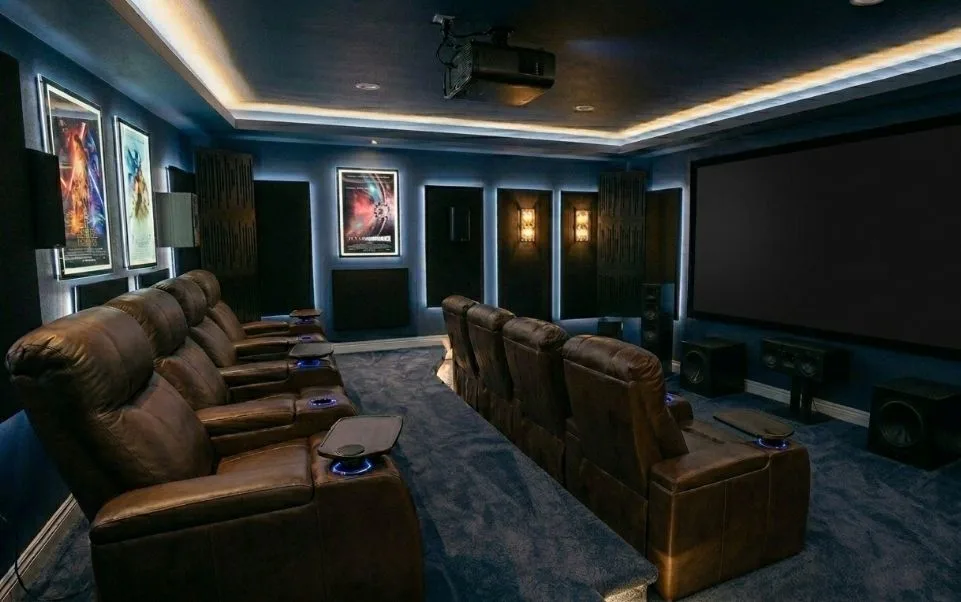
If you have a dedicated room with enough height, spectator seating is a classic choice, and this involves placing chairs on different levels or platforms. This tiered arrangement is one of the best home theater room design ideas because it solves the problem of the person in the front row blocking the view of the person behind them.
To make this work, you need to build or buy risers, and these are sturdy platforms that elevate the back rows. When we design these spaces, we make sure the risers are high enough to provide a clear line of sight but not so high that the viewers feel they are hitting the ceiling. Adding small LED lights along the edge of the steps is also a smart way to make the room safer and give it that authentic cinema feel.
Comfort Seaters
A chair is only as good as its padding, and comfort seats are designed specifically for long periods of sitting. These usually feature plush cushioning that does not flatten out after a few months of use, and a good back support is a necessity.
Width is another factor that people sometimes overlook, and you need enough room to move your arms and legs without feeling cramped. Seats with adjustable headrests are excellent because they allow you to tilt your head forward while reclining. This means you can look straight at the screen without straining your neck muscles, and we often suggest looking for materials that breathe, like high-quality fabric or top-grain material, so you do not get too warm during a long film.
Individual Recliners
For many, the individual recliner is the gold standard of cinema furniture, and yes, these chairs offer the most personal control. Most modern versions come with motorised parts that let you adjust the footrest as well as the backrest with the push of a button.
These chairs usually include extra features that make the experience more convenient, and you might find built-in cup holders, storage compartments for remotes, and even USB ports to charge your phone. Because they are separate units, note that you can arrange them in a slight curve as well. This ensures that every person is facing the centre of the screen directly, which improves the visual experience and the way you hear the surround sound.
Sectionals
If you want a more social atmosphere, a sectional sofa is a great alternative, and sectionals are modular, which means you can fit them into corners or stretch them across a long wall.
The beauty of a sectional is its versatility, and you can add a chaise lounge at one end for extra comfort. While they might not offer the same individual motorised control as a recliner, they make the room feel more like a home and less like a commercial building. This is a popular choice when the home theatre setup cost in India needs to be kept within a specific budget, as one large sectional can sometimes be more affordable than six individual motorised recliners.
Sofas
Never underestimate the power of a high-quality, deep-seated sofa, as a traditional sofa can be one of the most effective home theater seating ideas for smaller rooms or multi-purpose spaces. If the room serves as a living area during the day and a cinema at night, a sofa is the most practical piece of furniture you can own.
To make a sofa work for a cinema, look for one with a high back, and this provides the necessary support for your head and neck. You can also add ottomans or footstools so that people can still put their feet up, and using a few large, firm pillows can help people adjust their own seating position to get the best angle for the screen.
For Perfect Cinematic Experience
Seating is the physical part of the experience, but it must work in harmony with the technology because a chair that feels great but is placed in a spot with terrible sound will still result in a poor experience.
Right Speakers
The placement of your speakers should dictate where your seats go, and in a standard 5.1 or 7.1 surround sound setup, there is a best spot where the audio from all directions hits your ears at the perfect time. We work to ensure that your primary seating row is positioned exactly in this zone, and if your seats are too close to the back wall, the rear speakers might sound too loud and muffled.
Ideal Screen Size
If you have a 100-inch screen, sitting three feet away will make you feel dizzy, or if you sit twenty feet away, you lose the immersive feeling. A general rule is to sit at a distance that is roughly 1.2 to 1.5 times the diagonal width of the screen. And this ensures the image fills your field of vision without forcing you to turn your head from side to side to see the action.
Professional Home Theater Installation
Setting everything up yourself can be a big task, and there are cables to hide, acoustics to treat, and also furniture to assemble. Choosing a professional home cinema installation service ensures that all these elements are handled correctly.
As a home theatre expert in Kochi, we understand the local climate and housing structures, which helps us choose materials that last and sound systems that work with your specific walls. We handle the heavy lifting as well as the technical calibration so that all you have to do is sit down and press play.
The home theatre setup cost in India varies widely based on your choices, and investing in the right seating is a large part of that budget, but it is the part you will literally feel every time you use the room.
If you are ready to turn your spare room into a home theater that offers a perfect cinematic experience, we are here to help. From choosing the right chairs to the final calibration of your sound system, we handle every detail. Contact us at Climax Cinemas today to discuss your project and get a personalised quote
Frequently Asked Questions (FAQs)
Q1: How much space should I leave between rows of seats?
A1: You should try to leave at least 20 to 30 inches of walking space between rows when the seats are not reclined. And if you have power recliners, make sure there is enough clearance so the footrest does not hit the back of the chair in front of it.
Q2: Can I use regular living room furniture for a home cinema?
A2: You certainly can use regular living room furniture for a home cinema, provided the furniture allows you to sit comfortably for at least two hours and doesn’t sit so low that the person in front blocks your view. Many people start with a standard sofa and then upgrade to dedicated cinema seating later, as their budget allows.