
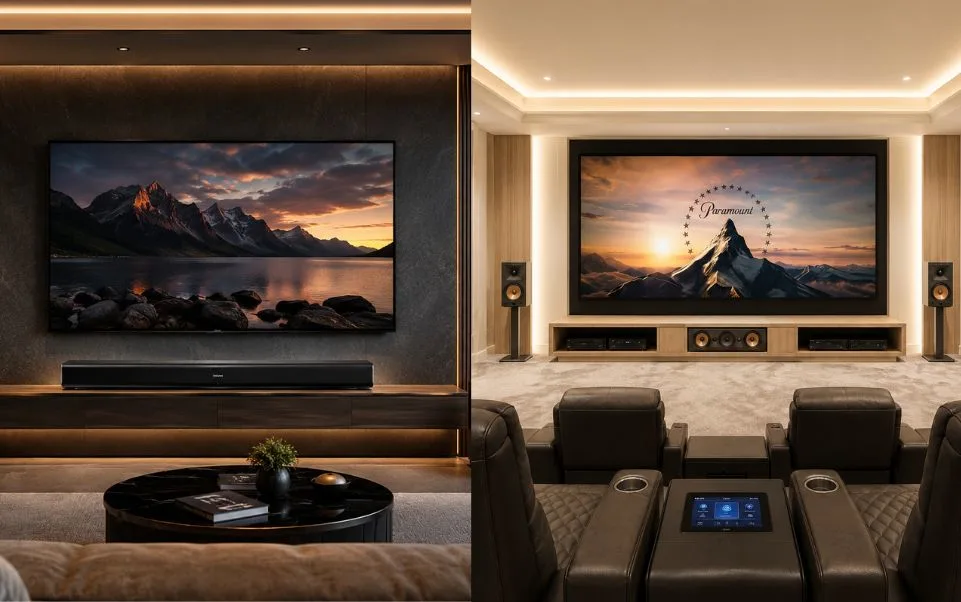
Sound Bar vs Home Theatre System: Which Gives the Best Cinematic Experience?

Comparing sound bar vs home theatre system helps you understand which gives the best cinematic experience for your setup. It is important to understand that a dedicated speaker system provides the most authentic cinematic experience for large rooms, due to its physical surround sound capabilities. And at the same time, a soundbar is preferred to be the top choice for smaller living areas. The choice between these two setups depends entirely on room layout, budget, as well as how much you value audio immersion.
Choosing the Right Audio Setup for Your Environment
When we look at how to build the best sound system for cinematic experience, it is important to consider the physical space first. Audio output can be different depending on the height of ceilings, the wall materials, and also the distance between seat and the screen.
Room Size & System Type
The size of your room is the main factor in deciding between a sound bar vs home theatre system and if you are setting up a television in a small bedroom or a studio flat, a soundbar is usually the most sensible choice. These devices are compact and sit neatly under your screen, and this provides a much-needed upgrade over thin, built-in TV speakers.
For medium-sized rooms, a standard home-theater-in-a-box might suffice and these kits usually include a receiver and several small speakers that are easy to hide. However, if you have a large space, such as a room measuring 20 feet by 10 feet or larger, these smaller systems will struggle. Larger rooms require more powerful, dedicated components that can move enough air to create a sense of scale. In these scenarios, a full home theater speaker system with separate amplification is the only way to achieve a really cinematic feel.
Specific Speaker Components
To get high-quality audio, the hardware inside the boxes matters and in our professional setups, we frequently use 6.5-inch dual-drive speakers. These two-way speakers are designed to handle a wide range of frequencies, and this ensures that the transition from deep bass to high trebles is smooth and natural.
One of the most overlooked parts of any setup is the center channel and in a professional cinema, the center channel handles almost all the dialogue. To ensure clear and impactful vocals, we recommend a powerful center channel featuring four drivers, and this configuration prevents voices from getting drowned out by loud explosions or background music, which is a common problem in cheaper audio setups.
Surround Sound Layout
By separating different audio elements into different physical locations, a multi-speaker setup creates an immersive environment, and this is how we can get a professional surround sound layout:
Front Left & Right
These speakers are mainly for music and large-scale sound effects that move across the screen and they set the stage for the entire film- Center Channel
As mentioned, this is dedicated to clear vocals and it ensures the actors sound like they are speaking directly from the screen - Side & Back Surrounds
These are used for background scores and spatial effects and by placing these behind or to the side of the listener, we provide audio separation that makes you feel surrounded by sound
Sound Bar vs Home Theatre System
Deciding between a sound bar vs home theatre system involves looking at the trade-offs between convenience and performance. A soundbar is an all-in-one solution and it uses clever processing to bounce sound off your walls, mimicking a surround sound effect. While this is great for saving space, it can never quite match the depth of having physical speakers placed around you.
A full home theatre system uses a dedicated receiver to power each speaker individually and this gives you much more control over the volume and tone of every channel.
| Feature | Soundbar | Home Theatre System |
|---|---|---|
| Ease of Setup | Very Easy (Plug and Play) | Complex (Requires Wiring) |
| Audio Depth | Moderate (Simulated) | High (Physical Separation) |
| Space Required | Minimal | Substantial |
| Customisation | Limited | Very High |
| Aesthetic | Discreet and Modern | Functional and Prominent |
Best Sound System for Cinematic Experience
Getting the best sound system for a cinematic experience is about the way the entire system works after home theater installation, and a true cinematic setup will provide the best experience that fully draws you into the content on screen.
To achieve this level of quality and great cinematic experience, many enthusiasts are now looking at a best sound system for home theater that includes height channels as well. A Dolby Atmos sound system adds a new dimension by placing speakers in or on the ceiling and this allows sound to move in a three-dimensional space.
At Climax Cinemas, we are the experts who design professional-grade, immersive home theater environments. We calibrate rooms to ensure the sound waves interact correctly with your furniture and walls. Be it a simple upgrade or about a Dolby Atmos sound system, we provide the technical knowledge needed to design the best home theatre in your space.
We understand that every space is different, and we work to ensure that the equipment we install matches the acoustic profile of each space. We focus on the tiny details that make a big difference, such as speaker toe-in and acoustic damping, to ensure you get the absolute best sound system for cinematic experience possible.
For the perfect home audio setup and home theatre installation, get in touch with Climax Cinemas.
Frequently Asked Questions
Q1: Can a soundbar actually replace a full home theatre system?
A1: A soundbar can replace a home theatre system if you have a very small room or if you want to avoid clutter. However, it cannot match the physical sound separation and deep bass that a system with multiple speakers and a dedicated receiver provides.
Q2: What is the benefit of a 6.5-inch speaker driver over smaller ones?
A2: The benefit of a 6.5-inch speaker driver over smaller ones is that the 6.5-inch driver is large enough to move a good amount of air, which helps in creating a fuller and richer sound. Smaller drivers often sound thin or tinny when you turn the volume up, whereas the larger driver stays clear and provides better mid-range performance.
Q3: Is it difficult to install a home theatre system by myself?
A3: Yes, it can be difficult to install a home theatre system by yourself as you have to run wires to the back of the room, calibrate the levels for each speaker, and also set up a receiver. Many people prefer to have professionals like us handle the installation to ensure the speakers are positioned perfectly for the best possible audio.