
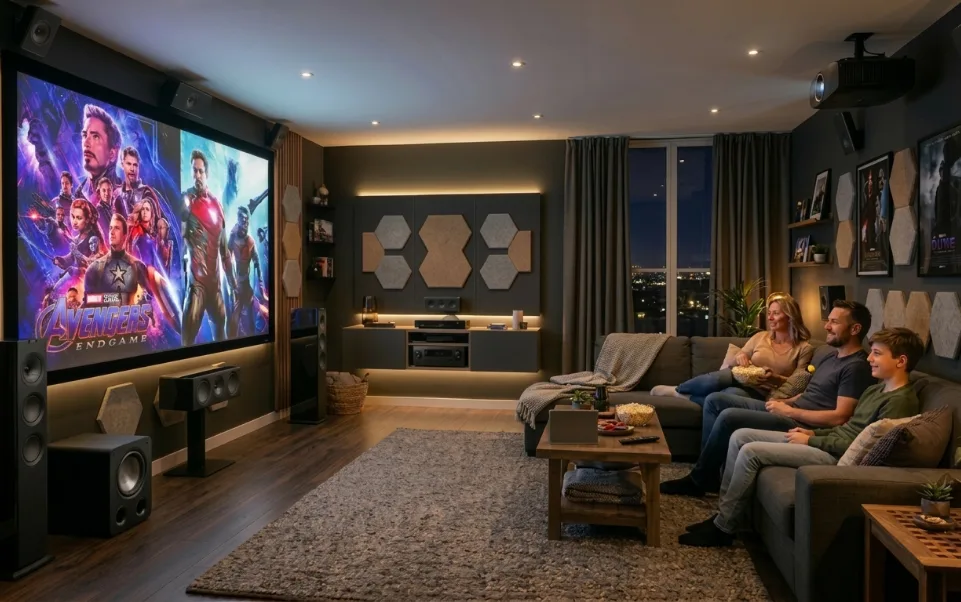
How to Plan Living Room Home Theater Design (Step-by-Step Guide)

Creating a cinema-like experience in your lounge involves arranging your furniture to face a high-quality screen, installing speakers at ear level, as well as using thick curtains to block out natural light. You do not need a dedicated windowless room to enjoy great movies. By making a few smart changes to your living room home theater design, you can turn a standard family space into a place where films feel truly beautiful.
Choosing the Right Screen for Your Space
The screen is the focus of any home cinema setup. When you pick a display, you should think about how far away you will be sitting. If your sofa is about three metres from the wall, a 65-inch or 75-inch 4K TV is usually a good fit. For those who want a larger image, a 4K projector and a fixed screen can provide that authentic theatre feel.
We suggest looking at OLED TVs if you mostly watch movies at night because they show perfect black levels. If your room stays bright during the day, a high-brightness QLED or LED screen might work better. Make sure the middle of the screen sits at eye level when you are seated. If you mount it too high above a fireplace, you might get a sore neck after a long film.
Getting the Sound Right with Speakers
Sound pulls you into a story. For the living room home theater design, we recommend a 5.1 surround sound system as a starting point. This includes a centre channel for clear dialogue, two front speakers for music and effects, two rear speakers for ambient sounds, and also a subwoofer for deep bass.
Where to Put Your Speakers
The center speaker should be positioned either directly above or just below the screen for best sound alignment. It is the most important part of the system because it handles almost all the talking. We advise placing the left and right speakers at an equal distance from the TV, angled slightly towards your favourite seat.
If you do not want wires running across the floor, we can look at in-ceiling or in-wall speakers. These stay hidden while providing high-quality audio. A subwoofer handles low-end frequencies, like explosions or deep musical notes. You can usually tuck this into a corner or beside the sofa. Since bass pass through walls easily, placing it on a small isolation platform can stop the floor from vibrating too much as well.
Adding Height with Atmos
Adding two height speakers for Dolby Atmos makes a big difference. This allows sounds to feel like they are coming from above you, such as rain or a plane flying overhead. We find that even small speakers that sit on top of your existing front towers can achieve this effect without cutting holes in your ceiling.
Also Read:What Is Dolby Atmos Sound? Everything You Need to Know
Managing Light and Room Acoustics
Living rooms usually have lots of windows and hard surfaces like wooden floors or large glass coffee tables. These can cause two problems: glare on the screen and echo in the audio.
To fix glare, we recommend blackout blinds or heavy velvet curtains. These block light and absorb sound reflections. If your room has a lot of echo, putting down a thick rug between the sofa and the TV will make the sound clearer. Bookshelves filled with books also act as natural diffusers, scattering sound waves so they do not bounce harshly around the room.
Conclusion
A common worry is that a home cinema will ruin a nice living room. We solved this by using smart storage solutions. Media cabinets can hide Blu-ray players, gaming consoles, and amplifiers. You can install an infrared repeater so that your remotes still work even when cabinet doors are closed. We also use cable management sleeves to keep wires tidy and out of sight.
Our team at Climax Cinemas focus on creating systems that fit your preferences and budget. Whether you need a simple soundbar upgrade or a full surround sound installation, we can guide you through the process.
To learn more about our services, contact Climax Cinemas.
Frequently Asked Questions (FAQs)
Q1: Can I have a home cinema in a small living room?
A1: Yes, you can. In smaller spaces, we recommend using a high-quality soundbar with a wireless subwoofer and a wall-mounted TV to save floor space. This keeps the room tidy while still providing a much better experience than standard TV speakers.
Q2: Should I get a projector or a large TV?
A2: It depends on how the lighting is in your room. If you can make the room dark, a projector offers a huge, cinematic image. However, if you use the room during the day with the curtains open, a large 4K TV is usually a better choice because it stays bright and clear in daylight.
Q3: How many speakers do I actually need?
A3: A 5.1 system is the standard for surround sound. It uses five speakers and one subwoofer. If your room is very large, you might want a 7.1 system which adds two more speakers at the sides to fill the space even more.
Q4: Will a home theater system increase my home value?
A4: A professionally installed and neatly integrated system can attract future buyers. It shows that the home is modern and ready for entertainment, though the main benefit is the enjoyment you get from using it every day.