
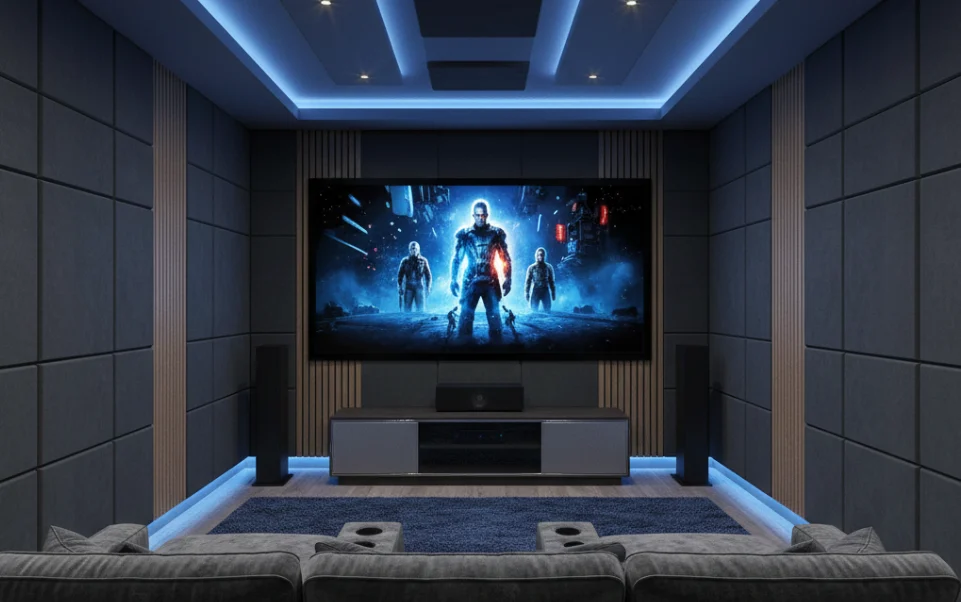
Home Theater Setup in South India: Mistakes That Increase Cost & How to Avoid Them

The dream of setting up a personal home cinema is exciting. It’s the idea of bringing the cinematic experience into your own space, with a large screen and immersive surround sound. As you begin planning your home theatre setup, it is natural to focus on selecting the right projector or choosing the best speakers.
However, a great home theater doesn’t just have to be about the equipment. It is about how all the components come together to create an engaging experience. Unfortunately, a few common and small mistakes made early in the planning process can lead to disappointment. Additionally, they can increase your costs, both upfront and long-term.
For anyone planning a home theater setup in South India, understanding these common mistakes is the first step to planning smartly. Avoiding them will save you money and also result in a more enjoyable cinematic experience.
Also Read: Essential Home Theater Setup Guide: Build Your Dream Cinema In Kerala & South India
Home Theater Setup Common Mistakes
The most common mistakes that occur during a home theater setup and how to avoid them are listed below.
1. Choosing the Wrong Room
The most important decision you should make before buying any equipment is choosing the room. Many people simply choose a spare room without considering its limitations.
Rooms with many windows let in too much ambient light, which washes out a projector’s image and creates distracting reflections on a TV screen. A perfect square or cube room is an acoustic nightmare, creating boomy, uneven bass. You might spend a lot more on heavy blackout curtains. In addition, you may need to invest in an extensive and expensive acoustic treatment to reduce the bad room acoustics. In some cases, the room’s problems will never be fully solved. And leave you with a compromised experience without your expensive gear.
If possible, choose a room with minimal windows and a rectangular, rather than square, shape. A room with solid walls will also contain sound much better than one with thin partitions. The right choice of room for home theater installation can save you a lot of money and hassle in the long run.
2. Mismatching Screen Size and Viewing Distance
When it comes to screen size, it is commonly believed that bigger is better. But it is important to note that this is not really true. There is no perfect screen size for every room, and it is directly related to how far away you will be sitting.
If your screen is too large for your viewing distance, you will sit too close. It may even break the illusion, and you may see the pixel structure of the image, which can cause eye strain. If the screen is too small, the experience will lack impact and feel unreal.
In this case, either you end up spending too much on a screen that is too large for your space, or you end up disappointed and want to upgrade to a larger screen later, which will cost you twice as much.
Use a simple method. A good starting point for the main seating position is a distance that is about 1.5 to 2 times the diagonal measurement of the screen. If you don’t know the dimensions of the room, a professional designer can assist you in calculating the perfect size.
3. Believing All Cables Are the Same
The cables that connect components are the vital elements of home theater systems. While you don’t need to spend a lot of money on expensive, overpriced cables, there is a real difference in quality. Using a cheap, uncertified HDMI cable for a 4K projector or very thin, poor-quality speaker wire for powerful speakers can compromise the performance of the entire system.
A bad HDMI cable can cause signal dropouts, sparks on the screen, or failure to transmit 4K signals at all. Poor speaker wire can restrict amplifier power, resulting in thin and lifeless sound quality. You will end up having to re-run and replace the cables, which can be a difficult and expensive job if they are already hidden behind walls.
Invest in certified HDMI cables that handle the bandwidth required for 4K video. For speakers, make use of good-quality speaker wire of an appropriate gauge for the run.
4.Underestimating the Value of Professional Installation
A professional home theater installation is not just about installing the screen as well as connecting the wires. It is a complete service that ensures every component of the system works together in perfect coordination. A DIY installation can lead to a number of issues. Speakers might be placed in acoustically poor positions, the speaker might be calibrated incorrectly, and this can lead to boomy bass. The projector’s picture settings might be left in factory default mode, which is rarely accurate.
Professional home theater installation is the most important component of your home theater setup. A company that specialises in home theater installation in Kerala, like Climax Cinemas, has the expertise and specialised tools to adjust Dolby Atmos system. Your projector to the unique acoustics as well as the lighting of the room.
Conclusion
It is possible to create a wonderful home cinema. By avoiding these common mistakes, you can plan smartly and ensure that your budget is invested in a way that delivers the best performance. Choosing the right room, working with the right professionals, and making informed decisions are all part of the process.
If you want to start planning home theater setup the right way, contact Climax Cinemas.
Frequently Asked Questions (FAQs)
Q1: What is the biggest mistake that increases home theatre costs?
A1: The biggest mistake that increases home theatre costs is poor initial planning. For example, choosing the wrong room can force you to spend extra money on blackout solutions and extensive acoustic treatment to fix problems. All these problems could have been avoided by selecting a more suitable space in the beginning itself.
Q2: Is acoustic treatment really necessary for good sound quality?
A2: Yes, acoustic treatment is really necessary for good sound quality. Even the best speakers in the world will sound poor in a room with a lot of echo and hard, reflective surfaces.
Q3: Can I use my existing living room for a home theater setup?
A3: Yes, you can use your existing living room for a home theater setup. While a dedicated room offers the most control, a home theater setup can be designed for a multi-purpose living room. This might involve choosing a projector with higher brightness to handle ambient light, or using more discreet in-wall or in-ceiling speakers to save space and maintain the room’s aesthetic.
Q4: Why should I hire a professional for my home theater installation?
A4: A professional installer brings expertise in room layout, speaker placement for the best surround sound, and ensures that every component of the system is performing at its absolute best.