
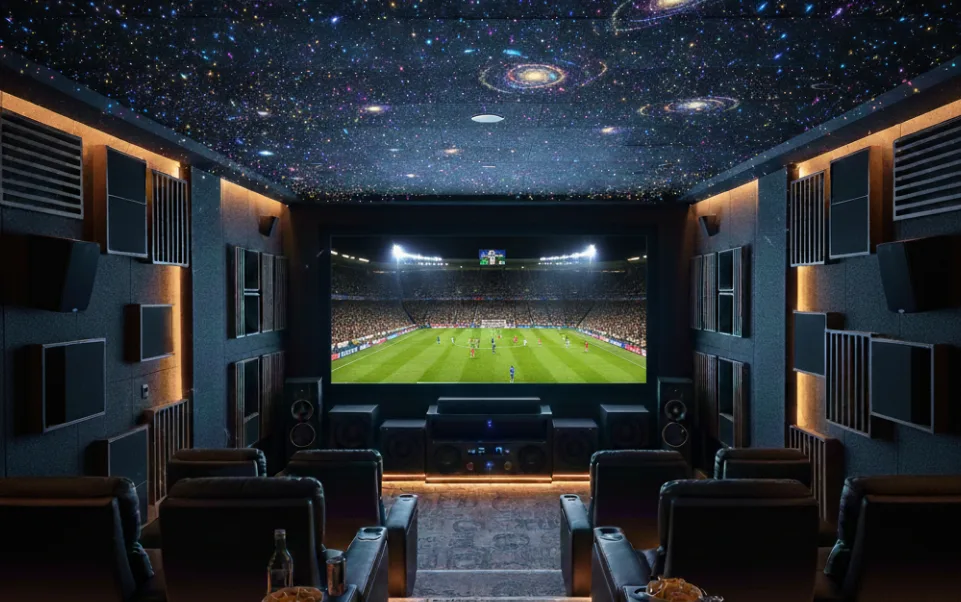
Engineering a High-End Home Theater: What Makes a Premium Setup

When it comes to high-end home theater, architecture, technology, and comfort come together to create something entirely different from a standard television room. When we discuss a premium setup, we mean a space that disappears the moment the film starts. Professional home cinema installations remove every distraction. To achieve this quality, you must move away from off-the- shelf solutions and adopt a customized approach.
1.Good Room Geometry
High-quality home cinema starts with the room itself. Every space has a natural voice, and some rooms speak better than others. Having parallel walls in a square room creates muddy audio, because sound waves bounce back and forth between them at the same frequency. Rectangular spaces are usually better for a surround sound system because they allow the audio to breathe and also develop.
When planning a media room, we look at dimensions long before speaker selection. If a room is too small, the bass becomes overwhelming. If it is too large, sound quality thins out.
A professional home theater installation company will measure the space’s cubic volume to ensure the chosen sound system can fill it without strain. This early planning prevents the common mistake of buying underpowered or unnecessarily large equipment for the environment.
2.Balancing Screen Size & Viewing Distance
There is a common belief that a larger screen is always better. In reality, the most important factor is the relationship between screen size as well as viewing distance. If you sit too close to a massive screen, your eyes must constantly move to track the action, which leads to physical fatigue. If you sit too far away, you lose the unique quality that defines a cinematic experience. And for the best home theater experience, the screen should occupy a specific portion of your field of vision. This is usually calculated to ensure the image is large enough to feel grand without being so wide that it requires head movement. With modern 4K and 8K displays, you can sit much closer than with older technology. This is because the pixels are so small that they remain invisible to the eye. This allows for a more impactful visual experience in smaller rooms.
3.Acoustic Treatment & Soundproofing
Sound travels through gaps, bounces off dense surfaces, and accumulates in corners. A premium home cinema requires two types of acoustic work:
- Soundproofing
- Room Treatment
Soundproofing
Soundproofing ensures that sound from the home theater doesn’t disturb the rest of the house. This involves adding mass to the walls and isolating the floor to stop vibrations travelling through the building’s frame.
Room Treatment
Acoustic treatment manages the sound quality inside the room. Those hard surfaces, like glass or plastered walls reflect sound, making dialogue unclear. By using a mix of absorbers along with diffusers, an installer can ensure that the audio from the speakers reaches the ears directly rather than bouncing around the room first. This creates tight, controlled sounds where every whisper is clear, and every loud sound has a clear start and stop.
4.Perfect Surround Sound System
A great sound system is about the ability to place sound exactly where it belongs in three-dimensional space. This is achieved through a carefully designed speaker setup. In a standard configuration, speakers are placed at ear level around the listener.
However, a premium installation usually hides these components behind acoustically transparent fabric. As a result, the audio is derived from the image itself, matching the visual action with the auditory source.
High-end setups rarely use one subwoofer. Using two or more subwoofers distributes bass more evenly across every seat. This prevents hot spots where one person feels too much vibration while another feels almost nothing. It creates a smooth, physical sensation that grounds the entire movie experience.
5.Implementing Dolby Atmos
Dolby Atmos changed cinema audio. Traditional surround sound moves audio around the listener in a flat circle. Atmos adds height. By installing speakers in the ceiling, we can make sound feel like it is coming from above.
With a standard surround sound system, that sound is stuck at ear level. It requires careful wiring as well as a powerful processor to handle the complex calculations needed to place these sounds accurately, but it is important to note that the result is a total transformation of the room’s atmosphere.
6.Selecting an AV Receiver
The AV receiver is the hub of the home theater. It handles switching between media players, decodes high definition audio formats, and also provides the power to drive the speakers. For a premium setup, the receiver must be capable of handling high-bit-rate video and audio without noise or distortion.
A common issue with lower-end receivers is that they run out of power during intense scenes. When a film reaches a loud climax, the receiver needs a large reserve of energy to keep the speakers moving accurately. If it lacks this, the sound becomes harsh and unpleasant. A high-quality receiver ensures that the sound remains effortless regardless of the volume level. It also provides the connectivity needed to integrate the cinema with the rest of a smart home system.
7.Designing a Modern Media Room
Not every home has a dedicated, windowless room to spare. Many people prefer a media room that serves as a social hub during the day and a theater at night. This presents unique engineering challenges, and in a multipurpose space, we must deal with windows, hard floors, and light coloured furniture.
The solution involves a lot of hidden technology. Motorised blackout blinds can be set up to control the light. Projector screens can be built into the ceiling, appearing only when needed. Speakers can be built into walls and painted over to remain invisible. This allows the room to maintain its interior design while still providing a superior home cinema experience.
8.Projectors vs. Large Format Displays
The choice between a projector and a large LED or OLED panel depends on the room’s usage. As you might know, projectors still offer the most authentic cinema feel and can produce images far larger than most televisions. However, they require a dark room to look their best. In a dedicated home cinema, a high contrast projector paired with a specialised screen is usually the top choice.
In rooms with more ambient light, a massive LED display might be more appropriate. These screens are very bright and offer deep blacks that are unaffected by daylight. Choose a display that can reproduce a wide range of colours accurately.
9.Seating Ergonomics and Sightlines
Premium cinema seating is designed for long-term support. Seating should be firm enough to prevent backache and, at the same time, soft enough to allow for total relaxation. Sightlines are also another main consideration. If there are two rows of seats, the back row must be raised on a platform to ensure everyone has an unobstructed view of the screen. We also consider the acoustic sightline to ensure that every seat has a clear path to every speaker. If the back of a sofa blocks a speaker, that listener will miss out on the fine details of the surround sound.
10.Proper Rack Management
The parts of a home cinema installation that you never see also play a major role. A premium home theater system requires a steady, clean supply of electricity. Power conditioners are used to filter out electrical noise that can cause grain in a picture or hum in a speaker.
Cabling also matters. While you don’t need to spend a lot of money on cables, you do need high-quality, shielded wires that can carry large amounts of data without interference. This is mainly important for HDMI cables running long distances to a projector. If the cable is poor, you will experience signal dropouts or reflections in the image. Proper rack management ensures that all these wires are organised and cooled, which will prevent the equipment from overheating.
11.Calibration
Calibration is where a professional technician uses specialised software and microphones to measure how the room is affecting the sound and picture. It is important to note that every room has peaks and dips in its frequency response. Calibration flattens these out and also ensures that the sound is balanced.
Visual calibration involves adjusting the white balance, brightness, and colour space of the display. Most screens are set to look good in a brightly lit shop, and in a home theater, they need to be adjusted to provide a natural, filmic look. This final tuning is what separates a DIY project from a professional home theater installation. It ensures that the investment made in hardware actually delivers the performance it is capable of.
Conclusion
A high-end home theater setup is an investment in the quality of your leisure time and cinematic experience. With years of expertise, Climax Cinemas provides home theater setups using the finest materials and equipment. Our home theater setup process includes site visit, design, product selection, acoustic treatment, and calibration. With a dedicated team of experts, we offer entry-level, mid-range, and luxury range home theaters.
To discuss your project, please contact Climax Cinemas.
Frequently Asked Questions (FAQs)
Q1: Can I install a high-end theater in a room with windows?
A1: Yes, you can have a high-end theater in a room with windows. This is possible by using motorised blackout blinds and an ambient light rejecting (ALR) screen.
Q2: Is a projector better than a 98-inch TV?
A2: It depends on the room. A projector can easily reach 120 to 150 inches, which provides a much more cinematic feel. However, a large TV offers better brightness and is easier to use in a multipurpose media room with some natural light.
Q3: How long does a professional home cinema installation take?
A3: The timeline for a professional home cinema installation varies depending on the complexity. A dedicated room with structural changes and acoustic treatment might take several weeks, while a high-end equipment upgrade in an existing room can be completed in a few days.