
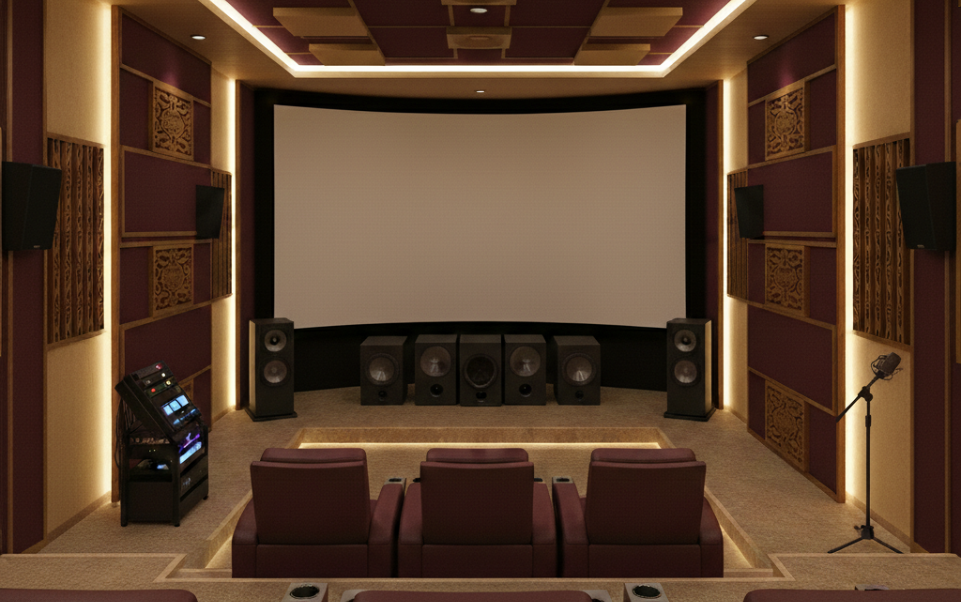
Inside a Professional Home Theater Setup in Kerala: Acoustics, Audio Channels & Calibration

Creating a perfect home theater is a lot more than buying a large screen and powerful speakers. We have all been to rooms with expensive equipment, but still felt disappointed. The sound might be unclear and indistinct, or the experience fails to draw you into the movie. There is a secret to a true cinematic experience hidden in the details that cannot be seen.
A deep understanding of how sound and light behave in a particular space provides deeper meaning to this experience. For anyone planning a home theater setup in Kerala, it is important to look at more than the components and focus on the room itself. The following are three pillars that make a simple media room into an excellent home cinema:
1.Acoustics
2.Audio Channels
3.Calibration
Also Read: Home Theater Setup In Kerala: Pricing & Budget Guide
Acoustics
Before any speaker is placed, the most important component of the home theatre is the room itself. Every room has its own sonic signature. A room with hard, parallel surfaces like tiled floors and bare walls will be full of echoes as well as reverberations.
It takes a split second for the sound waves from the speakers to reach the ears after bouncing off these hard surfaces. This creates a cluttered and also confusing audio image. If bass frequencies build up in the corners of the room, a boomy, one-note sound can result, while dialogue can become lost and difficult to understand. A professional designer understands room acoustics, and the first step is to tame the room with acoustic treatment. This is not about soundproofing, it is about controlling the sound inside the room, and this can be made possible by properly placing:
-Absorption Panels
These are soft, fabric-covered panels placed at the main reflection points on the walls and ceiling. By absorbing sound waves, they prevent them from bouncing around the room and creating echoes.
-Bass Traps
These are larger, denser panels placed in the corners of the room to absorb the excess low-frequency energy that causes boomy bass.
-Diffusion Panels
These panels have a rough, sculpted surface. Instead of absorbing the sound, they distribute it in multiple directions, which helps to create a more spacious and also natural-sounding environment.
Acoustic treatment allows speakers to deliver the clear, detailed sound they were designed to produce.
Audio Channels
The surround sound feeling of a great sound system comes from its ability to place sounds all around you. This is possible through a multi-channel setup.
A standard surround sound system uses several speakers, each with a specific job. A good surround system features a front left, centre, and right speaker, two surround speakers, and a subwoofer for bass. A sound system adds two more surround speakers for an even more powerful sound field. This is the starting point of an excellent home theater setup. Modern film soundtracks have evolved beyond this with Dolby Atmos. This technology adds a third dimension to sound, height. Adding speakers to the ceiling or using clever up-firing speakers, it creates a complete audio experience. This is the best home theater speaker setup for a modern cinema, as it allows sound to be placed around as well as above you.
Calibration
This is the final and perhaps most important step. Calibration is the process of fine-tuning every audio and video component to perform perfectly in a specific room. It is a complex process that requires specialised tools and expertise.
-Audio Calibration
Professional home theater installation will use an advanced microphone and powerful software to measure how the sound from each speaker behaves in the main seating position. They will then make micro-adjustments to the volume level, the delay, and the equalisation of each individual speaker. Thus, all the speakers provide a consistent and well-balanced sound field at the same time.
-Video Calibration
The projector or television is also adjusted, and a professional will use specialised light meter. And also software to adjust settings like brightness, contrast, and colour to meet industry standards. The colours will be natural, the blacks will be deep, and the images will have the right detailing as well.
Conclusion
A great home theater setup in Kerala is a deep understanding of room acoustics, a strategic approach to speaker layout, and careful professional installation. This combination of hidden details creates a cinematic experience that is watched and felt.
At Climax Cinemas, we develop complete, immersive environments. Our process is built on years of technical expertise and a love of the magic of movies.
Frequently Asked Questions (FAQs)
Q1: Is a dedicated, closed room necessary for a good home theatre?
A1: A dedicated room provides the best control over light and sound, but it is not a requirement. A fantastic home theater setup can be designed for a multi-purpose living room. This might involve choosing a projector with higher brightness to work in a brighter space, or using more discreet in-wall or in-ceiling speakers to save space and maintain the room’s aesthetic.
Q2: What is the ideal viewing distance for my screen size?
A2: A good rule of thumb for an immersive cinematic experience is to sit at a distance where the screen fills about 30 to 40 degrees of your field of view. A simpler way to calculate this is to multiply the diagonal measurement of your screen by 1.5 to 2.
Q3: Why is professional calibration so important?
A3: Every room affects sound and light differently. Professional calibration uses specialised microphones and light meters to measure these effects and then digitally corrects them in the AV receiver and projector. This process ensures that the audio quality is clear and balanced, and that the picture’s colours and brightness are exactly as the filmmaker intended.